
Your thermometer is lying: where to put the probe
By Tim · 26 October 2026 · 8 min read · Last reviewed 28 October 2026
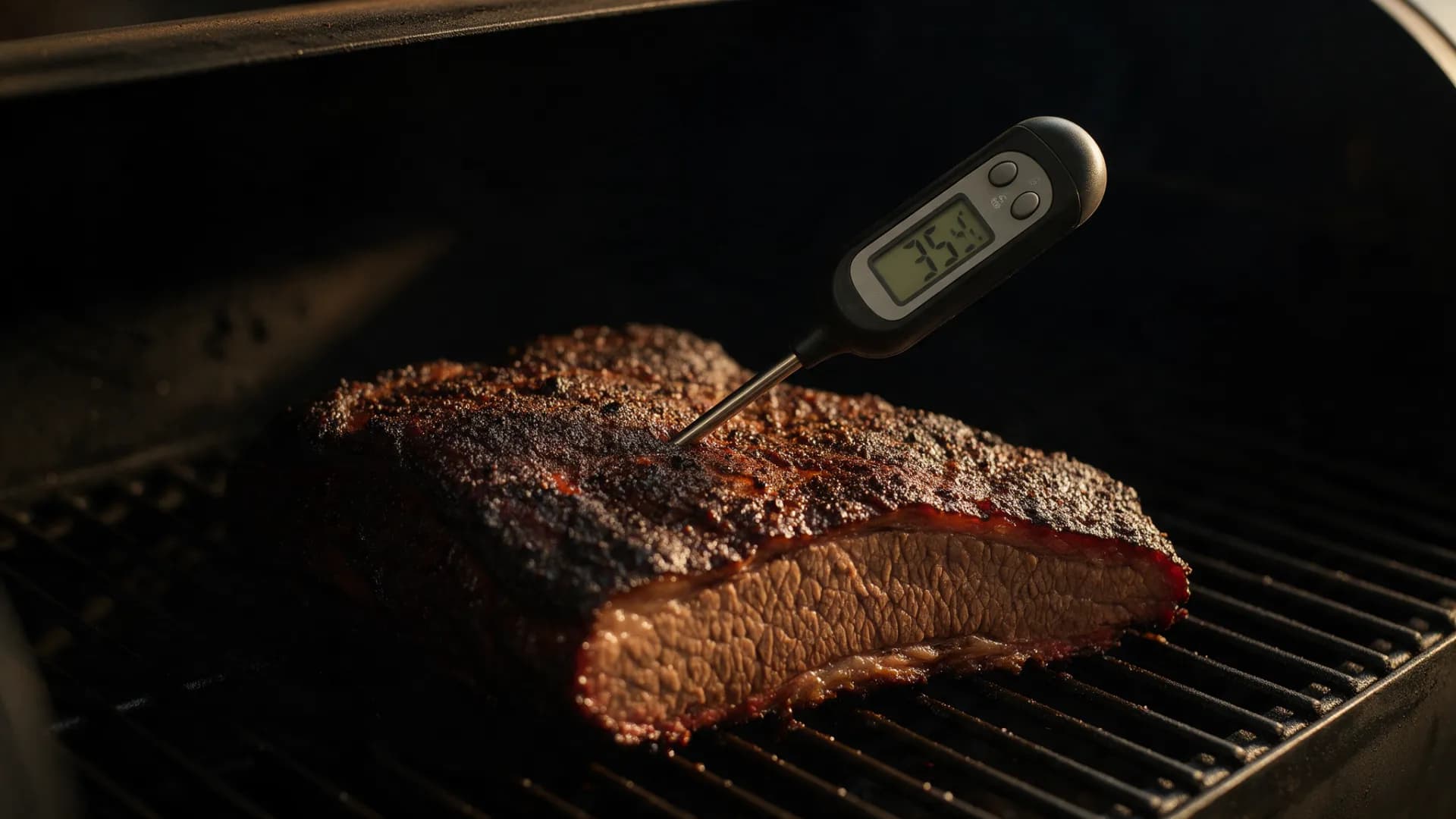
Put the tip of the probe in the centre of the thickest part of the meat, clear of bone and the fat seam. On a brisket, use one probe in the flat and one in the point, because they're different muscles. Check the thermometer reads 0°C (32°F) in a glass of iced water, and read the pit with a probe at grate level beside the meat.
On this page · 11 sections
Your thermometer may well be honest with you. It's just reporting on wherever the tip ended up, and meat isn't one temperature all the way through. Though some thermometers are out as well, dials especially.
Two meat probes, °C, one cook on 26 July 2026
- Lean
- Point
- Read straight after handling
- Meat moved toward the stack, some time before 07:45
- Wrapped, 08:54: both read straight after handling, so both low
- Probe tender, pulled, 11:24
- In the hold, 12:12: the point now warmer
2.1 kg flat-dominant brisket, Hark offset, ThermoWorks RFX leave-in lean and point probes, not calibrated. The dashed stretch spans the move; the line breaks at the wrap, where both were read straight after handling.
See every reading as a table
| Time | Lean | Point |
|---|---|---|
| 06:52 | 54.2°C | 48.2°C |
| 07:45 | 62.4°C | 62.7°C |
| 08:54 (wrap, after handling) | 64.0°C | 70.4°C |
| 10:04 | 78.1°C | 79.2°C |
| 10:42 | 87.5°C | 86.8°C |
| 10:59 | 89.8°C | 89.7°C |
| 11:24 | 92.3°C | 91.8°C |
| 12:12 (in the hold) | 86.7°C | 89.9°C |
Why do two probes in the same brisket read differently?
Meat cooks from the outside in. The outside is always ahead, and the centre of the thickest part is the last bit to get there. Greg Blonder measured it in 2013 on a brisket flat in a smoker at 107°C (225°F), and for roughly the first two hours the centre ran about 11°C (20°F) behind the surface before the two came together in the stall. Which means a tip a little off the centre is reading a different bit of meat.
The point and the flat are different muscles too, and in a 2025 Texas A&M study of 96 briskets they responded differently to the finishing temperature and the hold. So one probe in each was never going to agree all day.
I had a probe in each end of a 2.1 kg flat-dominant brisket on my Hark in July.
| Time | Lean (flat) | Point | What happened |
|---|---|---|---|
| 06:52 | 54.2°C (129.6°F) | 48.2°C (118.8°F) | Lean 6°C (10.8°F) ahead |
| 07:45 | 62.4°C (144.3°F) | 62.7°C (144.9°F) | Crossed, after I moved the meat toward the stack |
| 11:24 | 92.3°C (198.1°F) | 91.8°C (197.2°F) | Probe tender, pulled |
Most likely they were just in different meat, and moving the brisket changed which end got more of the heat.
Where should the tip sit?
In the centre of the thickest part, in muscle. Keep it off the bone and out of the gristle and the fat seam that runs between the point and the flat. On a brisket that means one probe in the flat and one in the point, each with its tip in the middle of its own muscle.
To find the true middle, push the probe a little past the centre, then draw it back slowly and watch for the lowest number. Check a second spot on a big piece, and give the number time to settle. In one study instant-reads took 16 to 55 seconds, though yours may well be quicker.
Bone matters less on a long cook. In Blonder's tests the meat beside the bone in a thick steak ran about 6°C (10°F) cooler than the centre, whereas in a 3.6 kg (8 lb) pork shoulder the two were at most about 4°C (7°F) apart and level by the stall. Fat is only a mild insulator too. I'd still keep the tip in muscle, it's the meat you're cooking after all.
Not every thermometer reads one point
Digital thermometers sense at the tip, so at least 12 mm (½ inch) in covers both main kinds. A dial thermometer is the odd one out. It senses along a coil 5–6.5 cm (2–2½ inches) up the stem and gives you the average over that length, so it can't read one spot at all.
- Flat probe, in from the side: tip in the centre of the thickest part of the flat.
- Point probe: tip in the centre of the point, clear of the seam.
- Wrong: tip in the fat seam between the two muscles.
- Wrong: pushed through and out the far side.
- Thermocouple. Senses at the very tip. About 6 mm (¼ inch) in is enough.
- Thermistor. Senses in the tip, but needs at least 12 mm (½ inch) in.
- Dial. Senses along a coil 5–6.5 cm (2–2½ inches) up the stem and reads the average of it.
A drawing, not a measured brisket. The stems are drawn to one scale, from the USDA’s figures; amber is where each one senses.
On a 1.1 kg rack of baby backs in August my analogue dial read 70°C (158°F) at the wrap, possibly against a bone, then 72°C (162°F) in one spot and 82–85°C (180–185°F) when I moved it. On a smaller rack in September I couldn't get the probe to the maker's depth at all, so on that cook I didn't use internal temperature to decide when to wrap.
For thin cuts go in from the side. The USDA's test kitchen found 92% of people didn't push the thermometer fully into a sausage patty, which means they were reading the top of it.
Is your thermometer accurate?
Maybe not, if it's a dial. In a 2014 test of 18 thermometers in a water bath at 71.1°C (160°F), all nine digital ones read within 1°C of the reference straight out of the packet. Seven of the nine dials were out by 1.3–7°C (about 2–13°F).
Australian food businesses have to use a probe thermometer accurate to within 1°C (about 2°F), and that's a fair standard for your backyard too. Fill a glass with crushed ice, top it up with water and stir. Push the probe at least 5 cm (2 inches) in without touching the glass, wait 30 seconds, and it should read 0°C (32°F).
Boiling water works too, though it's only 100°C (212°F) at sea level and about a degree cooler for every 300 m up. So ice is the cleaner check.
What is the lid gauge measuring?
The air up near the lid. Your meat is down on the grate, and heat isn't even through a cooker. My Hark has two hood gauges and I use them to balance the deflector plates, but even if the hood gauges are reasonably the same the grate temp is a whole different ball game.
So read the pit with a probe at grate level, right beside the meat. On that brisket in July the two probes I had at grate level either side of the meat read 124.3°C (255.7°F) and 111°C (231.8°F) at the same moment. Most likely they were in different air. Running a thick-steel offset goes into the pit side of that properly.
Copy what the brisket scientists do
The researchers who cook briskets for studies keep it simple. In a 2024 Texas Tech study they put one probe in the thickest portion of the smallest brisket in each smoker, and before they wrapped at 66°C (151°F) or pulled at 93°C (199°F) they confirmed the number with a calibrated instant-read. Which is something you can do at home, leave a probe in to watch the climb and check with a second thermometer before you make the call.
Even then the number is only a guide. On that July brisket both probes read just under 90°C (194°F) and it still had resistance. A leg of mutton in August felt soft all over at 89.2°C (193°F), under the 90–93°C (194–199°F) I'd planned to pull at, so I pulled it. Why low and slow works has more on probing for tender.
An injected brisket needs a centre reading
Injected, rolled, minced and marinated meat has to reach 75°C (167°F) in the centre, because the bacteria that normally sit on the surface can now be inside. That July brisket was injected the night before. A finished brisket is well past 75°C, though it's the centre of the thickest part where it counts.
Watch out for American sites giving 145°F for pork, because in Australia it's 70°C (158°F).
At your pit
- Before your next cook, put every thermometer you own in a glass of iced water and see what it says.
- Put one leave-in probe in the flat and one in the point, tips in the middle of each muscle and clear of the fat seam. Push them in as deep as your probe's manual asks for.
- Put the pit probe at grate level beside the meat, and leave the lid gauge for balancing.
- Before you wrap or pull, check with an instant-read in a couple of spots. Go past the centre and draw it back for the lowest number.
- On ribs and other thin cuts, go in from the side.
Quick answers
Why do my two thermometers show different temperatures in the same meat?
Both can be right, about different spots. Meat cooks from the outside in, so a tip slightly off-centre, near a bone or in the other muscle reads differently. Early in a smoke, one experiment found a brisket's surface about 11°C (20°F) ahead of its centre. The other cause is the thermometer itself, since in one test most dial thermometers were 1.3–7°C out. Put both in iced water to find out which it is.
How do I check my meat thermometer is accurate?
Fill a glass with crushed ice, top it up with cold water and stir. Put the probe at least 5 cm in without touching the glass, wait 30 seconds, and it should read 0°C (32°F). Boiling water works too, but it's only 100°C at sea level and boils cooler as you go higher. Australian food businesses must use a thermometer accurate to within 1°C, which is a sensible standard at home.
Can I leave the probe in the meat for the whole cook?
Yes, if it's made for it. A leave-in or oven-safe probe with a heat-rated cable can stay in, whereas an instant-read isn't built to. Push it to the depth in the maker's manual with the tip in the thickest part. In one Texas Tech study, researchers smoking briskets did exactly that, then double-checked with a calibrated instant-read before they wrapped or pulled.
Read next
 Why low and slow workswhy probe tender beats any number.
 Running a thick-steel offsetwhy one side of the pit runs hotter.
 Brisket, start to finishthe whole cook, probes included.
For the curious
The outside-in lag is a thermal gradient, and the last spot to heat is the thermal centre. Digital probes are thermocouples (USDA says about 6 mm in is enough) or thermistors (at least 12 mm), and dials use a bimetallic coil, from the USDA's Kitchen Thermometers sheet (2011).
Blonder's measurements are on his own site, To the bone for bone and fat and Thermal carry-over for the brisket surface and centre. The dial and digital test is Zemmer-Nalivka et al. 2014 in Food Protection Trends. The ±1°C rule is in the FSANZ thermometer fact sheet. How researchers probe a brisket is in the methods of Johnston et al. 2024 and Kerth et al. 2025. Australian safe temperatures are on the Food Safety Information Council's safe cooking temperatures chart.
If you're between Rockhampton and Bundaberg and would rather someone else stood at the pit for your next event, that's what I do. Get a rough price →