
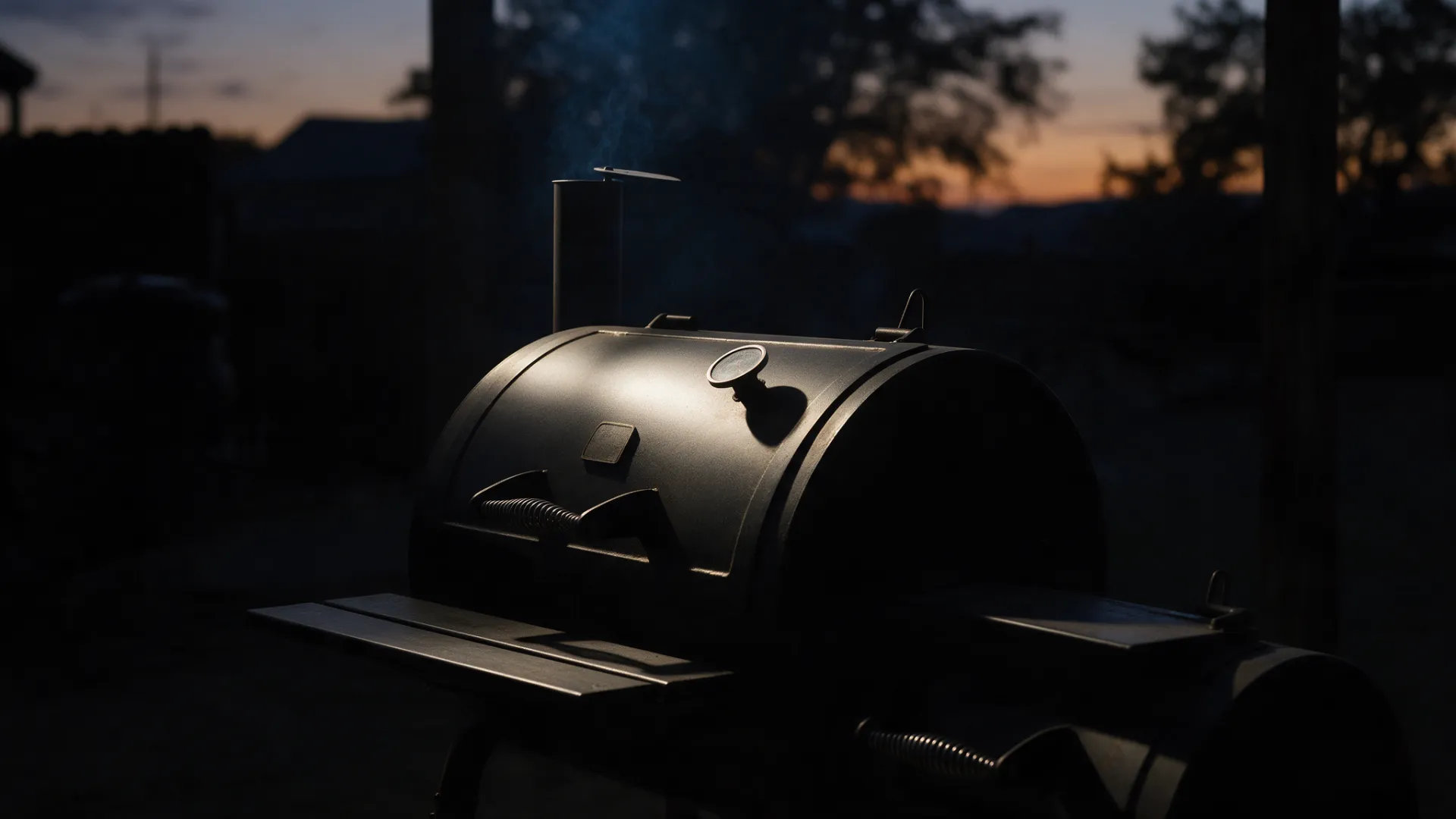
Clean smoke: thin blue vs thick white
By Tim · 27 October 2026 · 10 min read · Last reviewed 28 October 2026
Smoke colour tells you how well your wood is burning. Thin, bluish, nearly invisible smoke means most of the gases coming off the wood are burning up, and what's left is very fine. Thick white smoke means wood is fuming without catching. You get the thin stuff from dry wood, plenty of air, a hot bed of coals and splits that catch straight away.
On this page · 10 sections
What is smoke, actually?
Wood cooks before it burns, and smoke is what comes off it. When a split heats up, the wood breaks apart into hundreds of compounds that drift off as gas and tiny droplets, mostly somewhere between roughly 200°C and 500°C (390–930°F). Different parts go at different temperatures. The softer fibres break down first at about 200–250°C (390–480°F) and give sour, vinegary acids. Cellulose follows at about 280–320°C (540–610°F) with sweeter, bready notes, and the lignin, the tough stuff holding the wood together, goes around 400°C (750°F) and gives the classic smoky, spicy, clove-like flavours.
Most of that flavour travels as a vapour you can't see. The haze you can see is tiny droplets and particles, and they carry more of the colour. Which means you can be smoking the meat even when you can barely see anything coming out of the stack.
Charcoal makes hardly any smoke because all of that was cooked out of it when it was made. It burns at up to about 1,000°C (1,800°F) with almost nothing coming off it, so in a charcoal and split fire the smoke is coming from the wood.
Why is some smoke blue and some white?
Mostly it's the size of the particles. The tiniest ones, under about a thousandth of a millimetre, scatter blue light more than red, so a thin smoke looks bluish. Bigger droplets, a few thousandths of a millimetre, scatter every colour the same and look white. Bigger and sootier again and it goes grey to black.
In a lively fire a lot of the gas coming off the wood catches fire itself. Those flames dancing above the split are the wood's gases burning. What's left is less, and finer, so it looks blue. When the wood isn't burning properly the half-cooked gas escapes, and you get big white droplets and lots of them.
You've seen it with a candle. A burning candle barely smokes, but blow it out and a thick white ribbon pours off the wick, because the wax is still turning to vapour and nothing's burning it. A split that's fuming without catching is doing the same thing.
Some white smoke is normal though. When you light up, and for a few minutes after a new split goes on, the wood is drying out and heating up before it catches. And it isn't water vapour, which is invisible. The white you see is droplets, some of them water condensing on the smoke.
What makes white smoke
Four things, and more than one can be going on at once.
Wet wood is one. The water has to boil off first, which cools the fire, so the wood fumes instead of burning. In one measured test on home wood heaters, wood at 35% moisture made about 2.7 times as much smoke particulate as wood at 15%. How dry your wood should be is on its own page (Australian smoking woods).
Then there's air. Choke it and the wood keeps breaking down, but there isn't enough air to burn what comes off it. Franklin says cookers that restrict airflow give a more acrid smoke.
A cold or weak coal bed is the third. A split dropped onto a dying fire fumes for minutes before it catches, whereas a hot bed of coals gets it going fast. Which ties into the fourth, the cold split. My note on it says "a cold split spends its first minutes off-gassing before it ignites; a warm one catches almost immediately." So I keep the next split warming beside the firebox. My note from that July cook also says smaller splits catch faster and smoulder less.
Does white smoke really taste worse?
Experienced cooks say yes. Franklin describes dirty smoke as acrid with a bitter aftertaste, and Blonder calls smouldering, moist-wood smoke acrid too. Nobody has published a blind tasting of white-smoked against blue-smoked meat that I could find. So it's what cooks agree on, and the chemistry is consistent with it.
In measurements of wood burning, the smoky-tasting compounds come off mostly below about 800°C (1,470°F), especially when the wood smoulders, and drop away in hot, efficient flames. So a clean fire actually puts out less smoke flavour per piece of wood. Which is part of why it's hard to over-smoke meat on a clean fire, and easy to coat it in the harsh stuff on a dirty one. And it stands to reason that a long cook multiplies whatever smoke you're making, good or bad.
The flavour stays near the outside too. In Blonder's test only about the outer 6 mm (¼ inch) of a pork butt tasted smoky, so a harsh coating doesn't get watered down by the meat underneath. The wood might matter too. For the past year or more I've burned ironbark, and I reckon it's a stronger smoke than oak. I've heard other cooks say the same.
A bigger fire isn't a cleaner fire
You don't want flames everywhere either. In a wood-stove study, the roaring flaming stage after fresh wood went on made about seven to eight times the particulate (dark, sooty smoke) of the glowing-ember stage. The embers made more carbon monoxide though. Very dry wood can burn fast and sooty, and wet wood smoulders.
What you're after is a small, hot, steady fire with plenty of air, sitting on a bed of glowing coals and fed a little at a time. Smoke colour is about the fire, and the thermometer on the pit doesn't tell you much about it. On my mutton leg in August the stack never went dirty, even when the pit was down at 105–110°C (221–230°F), which is the hardest case to run clean.
Plenty of air, hot coals → most gases burn → thin blue
Wet wood, choked air or cold coals → gases escape → thick white
- Drying: water steams off, at about 100°C (212°F).
- Breaking down: roughly 200–500°C (390–930°F): sour acids first (about 200–250°C), then sweet notes (about 280–320°C), then the smoky flavours from the lignin (around 400°C).
- Gases catching fire: the flames above the split are the wood's own gases burning.
- Charcoal glowing: what's left, burning with almost no smoke.
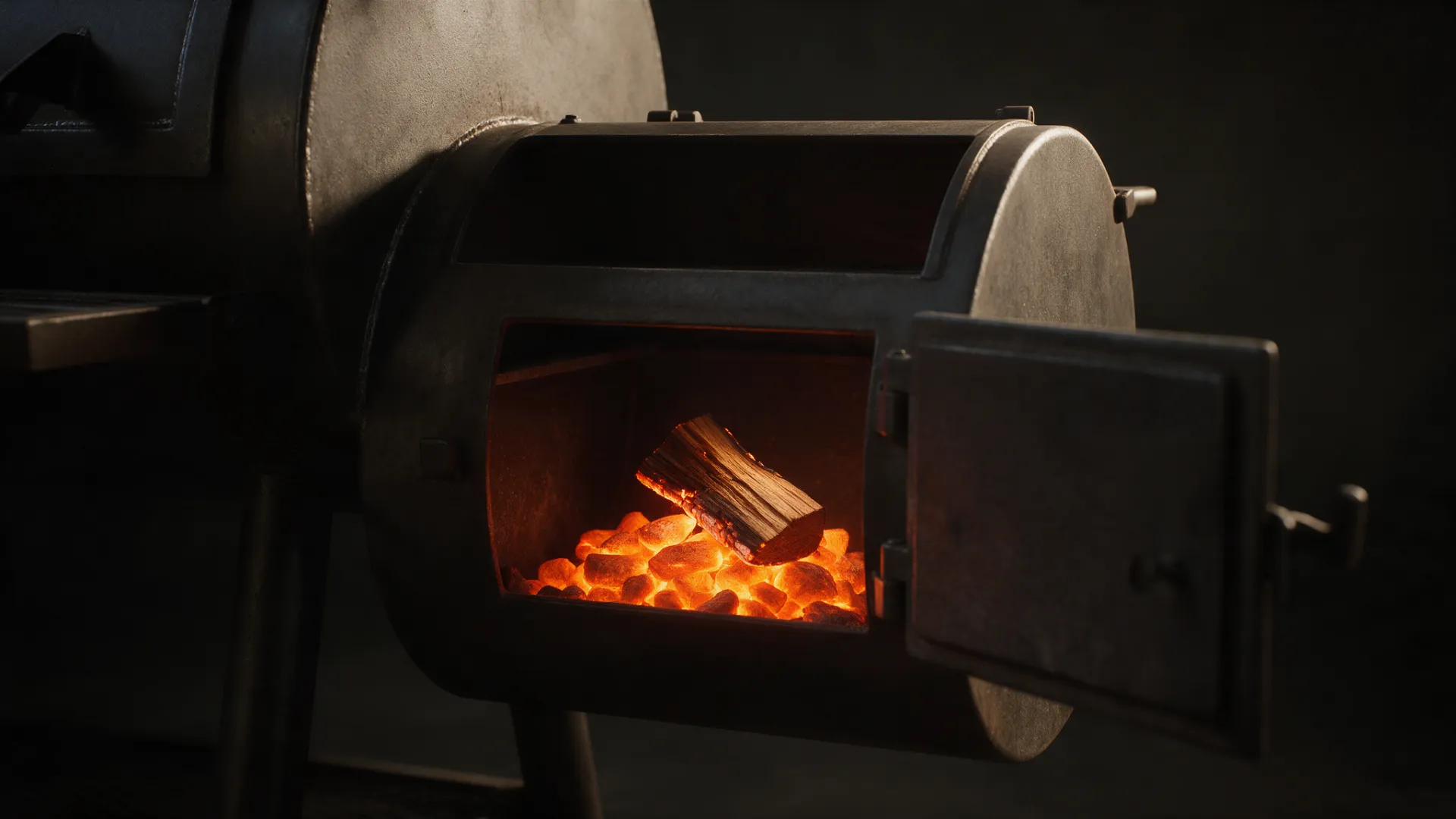
A drawing, not a measured fire. Amber is fire: the flames, the charcoal and the coals under the split.
What I've seen on my own pit
On my cooks so far, the way I've seen it go, dirty smoke starts with a rushed start. The meat goes on before the pit's settled, the fire overshoots, I close the vents to tame it, the fire smoulders and the stack goes white. Then I boost it to fix that, and the pit swings up and down for the rest of the cook. So now I light the charcoal about 90 minutes before the meat goes on.
On my 26 July brisket the charcoal went on at 04:00 and the meat at 05:30. For the first 30 minutes there was nothing to see, then light wispy blue, and it stayed clean throughout. The pit still sawtoothed between 82°C and 124°C (180–255°F) because I was adding wood late, and the smoke stayed clean through the dips. At the table it was the first brisket nobody called too smoky. My first brisket had a 45-minute lead and tasted maybe a touch strong. A lot else changed on the July cook though, the rub, the injection and the wrap among them, so it's one cook.
I put the clean smoke through those dips down to the fan. I give the fire a 60-second blast from a fan at every refuel, and it gets a split going fast. But my own note on it says the fan "makes late fuelling survivable", and therefore hides it. A clean stack after a late refuel means the fan worked. It doesn't mean the timing was right, so I judge my fuelling on the temperature curve.
On the August mutton leg I had the flattest fire I've ever run and no dirty smoke at any point. Though I'd also changed the wood that day, with a big split as the base and some locally bought wood, so I can't tell you which change did it.
If the pit runs hot, don't choke the air intake to bring it down. Ride out a small overshoot, skip the next split or crack the lid. My note on it says "the overshoot is temporary; the dirty smoke is permanent". How I run the Hark day to day is on its own page (running a thick-steel offset).
At your pit next time
- Give the fire time to settle before the meat goes on. Don't rush the start.
- Burn dry wood, and keep the next split warming beside the firebox.
- Add wood while the coal bed is still hot, before the pit temperature has dropped.
- Leave the air intake open. If it runs hot, skip a split or ride it out instead of shutting the air.
- A few minutes of white after a split goes on is fine. If it keeps pouring white, the fire needs air or the wood is too wet.
- Keep the meat away from direct flame. Hotter fires and flame touching food both raise the cancer-linked compounds in smoke (PAHs), and an offset already keeps them apart.
Quick answers
What is thin blue smoke?
It's the faint, bluish haze a wood fire gives off when it's burning well. Most of the gases coming off the wood are catching fire, so what's left is a small amount of very fine particles, fine enough to scatter blue light. It looks like there's hardly any smoke, but most smoke flavour travels as invisible vapour, so the meat is still being smoked.
Is white smoke bad for meat?
A few minutes of it isn't. White smoke is normal while a fire lights and for a short while after fresh wood goes on. Thick white smoke that keeps pouring out means wood is fuming without burning, from wet wood, too little air or a weak coal bed. Experienced cooks say it leaves a bitter, acrid taste on the outside of the meat.
Why does my smoker make white smoke after I add wood?
Because a fresh split has to dry and heat up before its gases catch fire, and for those minutes it fumes. Shorten it by keeping a hot bed of coals, warming the next split beside the firebox before it goes on, adding wood before the fire has died down and leaving the air intake open. If thick white smoke lasts more than a few minutes, the fire needs air or the wood is too wet.
Should I soak wood chips before smoking?
Sources disagree, and on an offset burning splits it doesn't really come up, because you want the wood dry. Greg Blonder and many cooks say don't soak, since the water makes chips steam and smoulder instead of catching, whereas Harold McGee's food-science book suggests soaking chips thrown onto charcoal so they cool the coals.
Can you over-smoke meat with clean smoke?
You can, but it's much harder. A clean fire puts out less smoky-tasting compound per piece of wood than a smouldering one, so a long cook builds flavour gradually. Over-smoking usually comes from a dirty fire, a very long cook or a strong wood. If you want less smoke flavour, start with a clean fire, then see barbecue for people who don't love smoke.
For the curious
Wood breaking down by heat without burning is pyrolysis, and the flames of the wood's own gases are secondary combustion. The smoky-tasting compounds are mostly methoxyphenols from lignin. Blue smoke is light scattering off particles smaller than its wavelength, the same physics as a blue sky (Indiana Public Media).
The temperatures for each part of the wood are from Harold McGee's On Food and Cooking (2004, p.449, Google Books) and Timothy Vazquez's 2022 Ohio State thesis. The wet-wood numbers are Xie et al. 2010, the smoky compounds are Kjällstrand and Petersson 2001, and flaming against embers is Mitchell et al. 2016. Franklin's views on dirty smoke are in Aaron Franklin and Jordan Mackay's Franklin Barbecue: A Meat-Smoking Manifesto (2015, Google Books). Greg Blonder's pages on smoke colour and wood fuel are worth a read. The carbon monoxide figures are from the MJA and NSW Health, and FSANZ's PAH survey found Australian exposure low.
Read next
 Australian smoking woodswhich wood, and how dry it needs to be.
 Running a thick-steel offsetthe fire, split by split.
 What bark actually iswhat that smoke does to the outside of the meat.
If you're between Rockhampton and Bundaberg and would rather someone else stood at the pit for your next event, that's what I do. Get a rough price →