
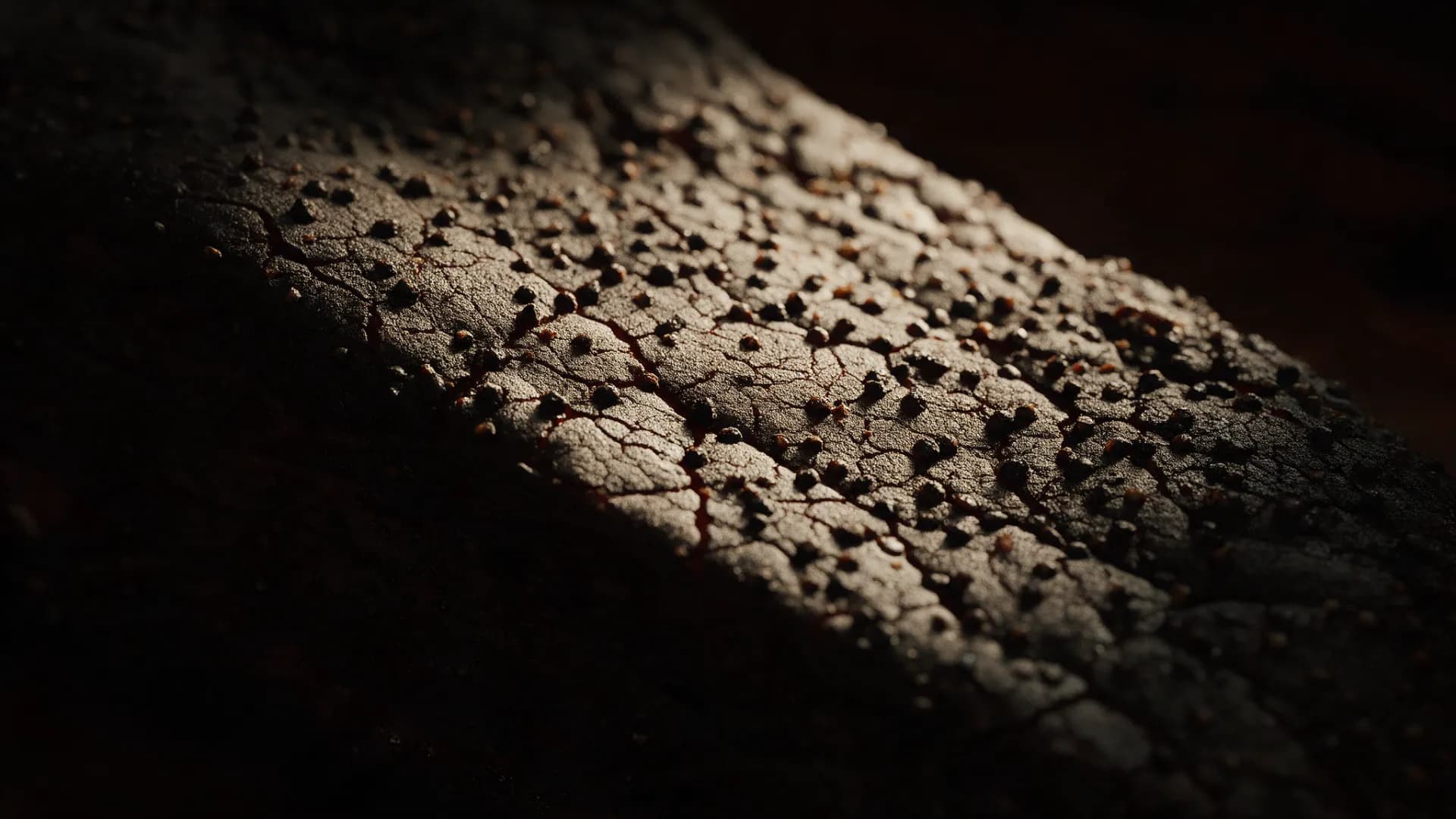
What bark actually is (and why it isn't burnt sugar)
By Tim · 27 October 2026 · 9 min read · Last reviewed 28 October 2026
Bark is mostly the meat itself. Over a long cook the surface of the brisket dries out and the protein there locks into a thin skin, usually under 1 mm thick. Slow browning and smoke colour it dark, and the rub sticks to it. It isn't caramelised sugar, and dark bark isn't burnt.
On this page · 11 sections
Meat: bark forms
Pure fat: no skin, no bark
- Rub and pepper, stuck on top. Flavour and texture sitting in the crust, not the crust itself.
- Dried protein skin, the meat's own surface, dried out and locked together, under 1 mm (about 1/25 inch).
- Browning and smoke colour, on and in the skin.
- Meat, below the skin.
- Water evaporates off the top.
- Smoke vapour dissolves into the damp surface.
A drawing, not to scale and not a measured brisket.
What is bark actually made of?
Mostly brisket. Take the rub away and what's left is a thin skin of the meat's own surface protein that has dried out and locked together, usually under 1 mm (about 1/25 inch) thick. Once those proteins have linked up, water won't undo it. You can't wash bark back into raw meat.
In one set of tests in 2013, Greg Blonder smoked meat with plain, salty, sugary, acidic and alkaline rubs and every one of them formed bark. A lump of pure fat in the same smoker formed none at all. So bark is really three things stacked up. The dried protein skin, the browning and smoke colour on and in it, and whatever rub is stuck to it.
It's a lot like the skin on a cup of hot milk left sitting. The top dries and the proteins set. Put cling film over it and no skin forms, which is pretty much what a wrap does to bark.
Why bark isn't caramelised sugar
You'll read a lot that bark is caramelised sugar. Table sugar doesn't caramelise quickly until about 160–165°C (320–330°F) though, and a low and slow pit runs at about 107–135°C (225–275°F). So the sugar in your rub can't caramelise quickly, and not at all while the surface is wet. Given hours on a dry surface it can slowly darken, and honey goes sooner (sugar in a rub).
The meat's surface is cooler again than the pit. While it's wet, water evaporating off it keeps it cool, the same sweating that causes the stall (why your brisket stops climbing). A wet surface can't get past 100°C (212°F), and in practice it sits well under that until it dries.
Plus sugar-free rubs still make bark. Blonder's did, and so have mine. My brisket on 26 July 2026 had no sugar in the rub at all and the bark still set, and so did a mutton leg I did in August with a savoury rub. The sugar side of things has its own page (sugar in a rub).
Why does bark take hours?
The browning on bark is the Maillard reaction, the same one that browns a seared steak or a slice of toast. Proteins and sugars in the meat react and make brown colour and roasted flavour. It doesn't switch on at a set temperature. It just goes faster the hotter it gets, and at smoker temperatures it crawls.
Blonder's examples show how slow. Sugar left overnight in a 121°C (250°F) oven stays white, and a chicken breast baked for an hour at 163°C (325°F) barely tans. At 107°C (225°F) it takes hours before you see any browning. Which is why low and slow suits bark so well. The surface has hours to dry and brown before the inside is done.
Airflow helps too, because moving air carries the moisture off the surface. An offset moves a lot of air through it, so the surface dries quicker than it would in a sealed cooker.
Smoke is what turns it black
Smoke vapour dissolves into the damp meat surface. Some of what's in it (the carbonyls) reacts with the meat's protein in the same kind of browning reaction, and that's most of the smoky brown. Other compounds (the phenols) form dark resins on the surface, which is where the shine comes from.
Without smoke, bark stops at a dark mahogany red. With smoke and time it goes shiny and nearly black. My no-smoke ribs never even got that far. On some baby back ribs I did on the gas Weber in August with no smoke and no sugar, the rub was still loose powder in patches and never fused into a crust. A month later on the same setup the bark did set, but it was light golden, dry and rough.
So black bark isn't burnt. A smoker runs far too cool to char meat, and burnt ends aren't burnt either. The pink ring under the bark is a different reaction altogether (the smoke ring).
Smoke sticks best to a damp surface though, which means there's a trade-off in every cook. A damp surface takes on more smoke colour, and a dry one forms crust faster. On my 26 July brisket I didn't spritz, apart from one light spritz on a dry patch of the point.
Temperature, °C (°F)
Fridge 5°C (41°F)where rubbed meat waits overnight
The stall, inside the meat 65–77°C (150–170°F)
A wet surface can't pass 100°C (212°F)
Pit air, low and slow 107–135°C (225–275°F)
Sugar caramelises quickly 160–165°C (320–330°F)
Where browning is fast 150–260°C (300–500°F)a speed, not a switch: slower below, never off
Bars start at 0°C. The stall is the meat’s inside, from the stall article; there’s no line for the meat’s surface, because no measurement of it was found.
What the rub actually does
Less than the labels on the bottles say. In Blonder's rub tests, salt and acid made bark form slightly faster, but by the time the meat was done every version was "more or less indistinguishable".
The salt and sugar in a rub dissolve in the moisture on the surface into a gritty paste that dries into the crust. Bigger bits like coarse pepper sit on top. So the rub is flavour and texture sitting in the bark. Fat doesn't make bark at all. It adds shine and carries the flavour of the spices, but under a thick fat cap no skin forms (trimming the fat side).
I've got a hunch that sugar in the rub slows bark down, because brown sugar holds onto moisture and keeps the surface tacky for longer. My 26 July brisket with no sugar set noticeably earlier than my first cook with a sugary rub. But that was a cold still winter day, and dry air may set bark faster too, so I can't tell you which one did it. It's something I suspect, I haven't shown it.
Binders like mustard or Worcestershire haven't been tested that I know of. Going by Blonder's rub results I'd guess they make little difference to the bark itself. And I put apple cider vinegar in my spritz, but that's for the flavour.
How I tell bark is set
I go by touch. My note for it says "Surface no longer tacky; rub has crusted and won't smear." That's my trigger to wrap.
On my first logged brisket in July 2025 the bark set 4 hours 30 minutes in, with the inside around 71°C (160°F) and the stall close to breaking, and I wrapped it then. Which fits the science, since the bark set as the surface finally dried. On the mutton leg the rub had no sugar or paprika and it never went dark, but it didn't rub off either. My note from that cook says "the real criterion is set, not colour". So a pale bark can be set, and a dark one might not be.
Before wrap you have to ask yourself if you are happy with the bark. If the bark isn't set then it's not time to wrap. It'll wash off in the steamy interior of the wrap.
What softens bark
Anything that wets the surface again. Spritzing, mopping, a very humid cooker and a wrap all slow bark down, because it needs a dry surface to form. In a braise or a sealed pot it never forms at all.
Once you wrap, the bark stops building. Paper still lets some moisture out, whereas a tight foil wrap traps the steam and can soften the bark you've got (paper vs foil). Pouring liquid into the wrap does the same. If it's gone soft, a short spell unwrapped in the pit dries the surface again. Spritzing has its own page (to spritz or not).
At your pit next time
- Keep the air moving through the pit so the surface can dry.
- Leave the spritz bottle alone if you want the bark to set sooner. Every spritz wets the surface again.
- Once the surface looks dry, touch it. If the rub won't smear or come off on your finger, it's set.
- Don't go by colour. A pale bark can still be set, like my mutton leg's was.
- Wrap once it's set, and use paper if you want to keep more of the crust.
- If the bark's soft after the wrap, give it a short spell unwrapped in the pit.
Quick answers
What is the bark on smoked meat made of?
Mostly the meat itself. The outer layer of protein dries out during a long cook and locks into a thin skin, usually under a millimetre thick. Slow browning and smoke then colour it dark, and the rub sticks to it. In one set of tests plain unseasoned meat still formed bark, while a lump of pure fat formed none, so the rub flavours bark but doesn't make it.
Is black bark burnt?
Usually not. A smoker runs far too cool to char meat. The near-black colour builds over hours as the surface browns and smoke compounds collect on it, and without smoke the same crust stops at a dark mahogany. Bark that tastes bitter or acrid is a different problem, which experienced cooks put down to dirty, smouldering smoke or sugar scorching over direct heat.
Does sugar in the rub make the bark?
No. Table sugar needs about 160–165°C (320–330°F) to caramelise quickly, which is hotter than a low and slow pit runs, and sugar-free rubs still form a full bark. Sugar adds sweetness and some colour by joining in the slow browning, and it may keep the surface tacky for longer. The crust itself is the meat's own dried surface protein, coloured by browning and smoke.
Why is my bark soft?
Because the surface got wet again or never dried. Bark is a dried protein skin, so anything that brings moisture back softens it. Wrapping before it has set, a tight foil wrap that traps steam, liquid poured into the wrap, heavy spritzing, a very humid cooker or sitting wrapped up tight for a long time can all do it. A short spell unwrapped in the pit dries the surface again.
When is bark set?
When you can touch it and the rub doesn't smear or come away on your finger. Go by touch rather than colour or the clock, because a pale bark can still be set, and a cold dry day can set bark faster than a humid one. A lot of cooks wrap at this point so the crust doesn't wash off inside the wrap.
For the curious
The dried protein skin is called the pellicle. The browning is the Maillard reaction, and the brown pigments it makes are melanoidins. In smoke, carbonyls brown the surface in Maillard-type reactions, and phenols form the resins that give bark its sheen. Caramelisation is a separate reaction that needs sugar on its own to get much hotter.
Blonder's bark tests cover the rub, fat and smoke results, and his page on how smoke deposits on meat explains why a wet surface takes more smoke. Harold McGee's On Food and Cooking (2004, pp.158, 176, 236 and 778–779) covers slow browning in moist foods, a barbecue surface drying slowly, and smoke colour on a pellicle (Google Books). The smoke colour chemistry is in Schneck 1981 and Timothy Vazquez's 2022 Ohio State thesis.
Read next
 Why your brisket stops climbingthe stall, and why the bark waits for it.
 Butcher paper vs foil vs nakedwhat each wrap does to the bark you've built.
 Sugar in a rubwhat sugar does do, and when it burns.
If you're between Rockhampton and Bundaberg and would rather someone else stood at the pit for your next event, that's what I do. Get a rough price →