
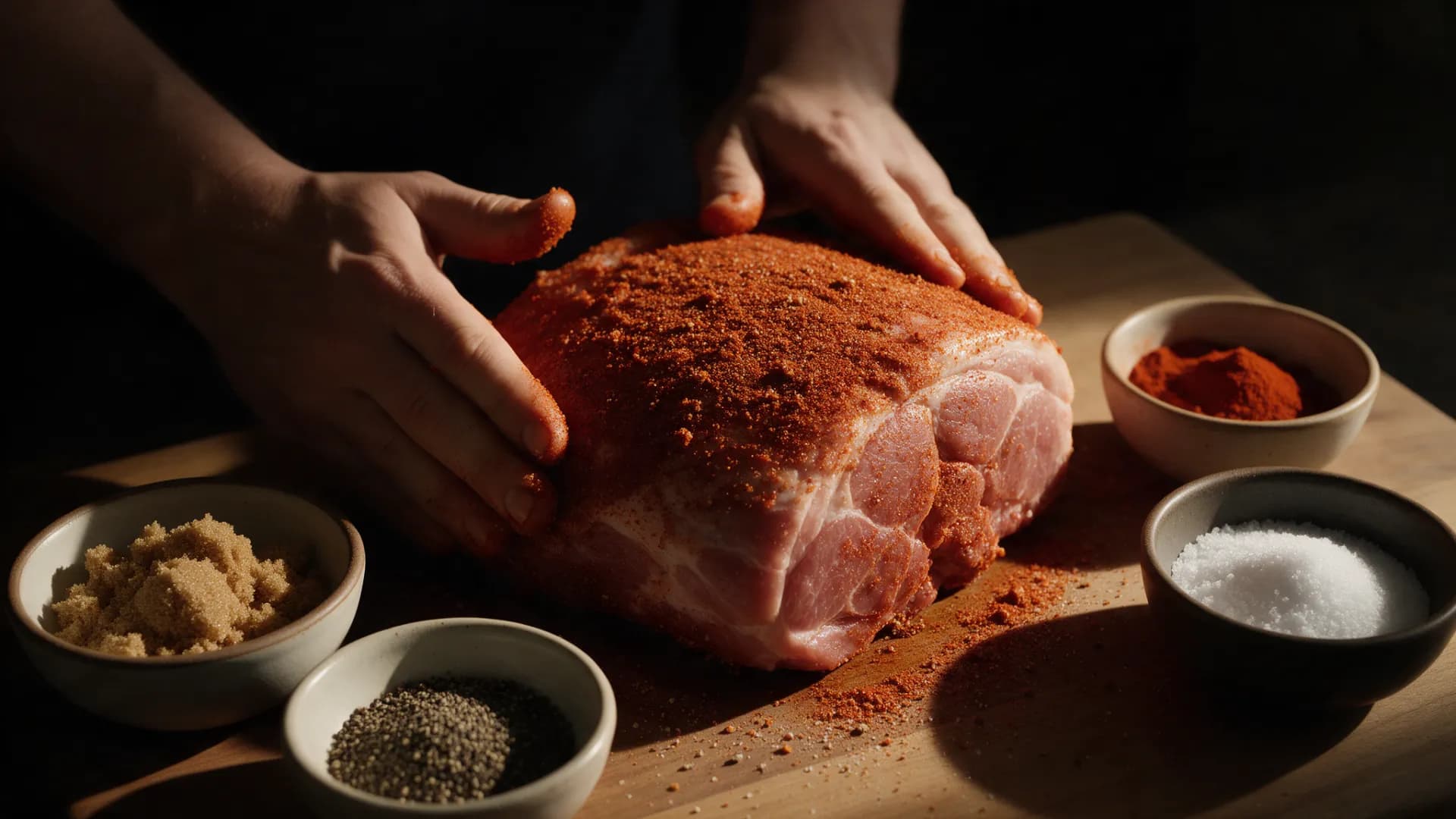
Sugar & spice: what sugar does in a rub, and when it burns
By Tim · 28 October 2026 · 9 min read
Sugar in a rub is mostly there for taste. It doesn't make the bark and it hasn't got one burning temperature. It burns on a clock, heat and time together, and only once the surface has dried out. In a smoker that's slow. Over coals it's minutes. Honey goes first, so the sweet sauce goes on at the end.
On this page · 10 sections
What's the sugar in a rub actually for?
Balance mostly. Sweet takes the edge off salt, sourness and bitterness. In lab taste tests in 2010, adding sugar to a salty mix pushed the saltiness down by more than three-quarters, while the sweetness held its own. That's on plain solutions in a lab, not meat, but it's why a rub with a bit of sugar in it tastes rounder than one without. Plus about 95% of Australia's sugar is grown in Queensland, so it's local too.
There isn't much of it either. One well-known competition-style rub works out to about a tablespoon of sugar on a whole slab of ribs.
The spice side is simpler. Pepper, paprika, garlic and the rest are flavour sitting in the crust.
What sugar doesn't do is make the bark. Rubs with no sugar at all still make bark, and so does plain meat (what bark actually is). My July 2025 baseline brisket had 5 tablespoons of brown sugar in the rub and my 26 July 2026 brisket had none, and both scored 4 out of 5 for bark. The weather, the wood, an injection and the rest of the rub were different too, so I couldn't see the sugar in the score either way.
At what temperature does sugar burn?
There isn't one number, and that's the surprising bit. Shelly Schmidt's lab at the University of Illinois found in 2011 that table sugar "doesn't actually melt" the way ice does. As it turns liquid it's already breaking down into new compounds. Heat it fast and it goes liquid at about 190°C (380°F). Heat it slowly over an hour and it went at about 145°C (290°F), because it had been breaking down the whole time.
Harold McGee took that home and browned sugar crystals in his oven at about 120°C (250°F), given many hours. So sugar works a bit like sunburn. You don't burn at a set temperature, it's how strong the sun is times how long you're out in it. A little heat for a long time or a lot of heat for a short time can get you to the same place.
As it goes, caramel gets less sweet and more bitter, and pushed further it goes black and acrid. That's burnt.
You'll see "sugar burns at 265°F" quoted all over American barbecue sites. That's about 129°C, and it traces back to a sauce maker's FAQ. If it were true every rub on a 135°C pit would burn, and they don't.
Water keeps a lid on it
Sugar in a rub doesn't stay as crystals for long. It dissolves into the wet surface of the meat, and a wet surface can't get past 100°C (212°F). In a smoker it sits a good bit cooler than that while it's sweating (why your brisket stops climbing). So early in the cook your sugar's in no danger at all.
Later in a long cook, once the surface dries, it can creep up toward the pit's air temperature, 107–135°C (225–275°F). That's still under the 160–170°C (320–340°F) where table sugar caramelises quickly. But it's above where fruit sugar starts, and given hours, sugar can slowly darken there. So a sugary rub does tend to go darker on a long brisket than on a short cook. I couldn't find anyone who's measured how fast on meat at smoker temps, so take that as the chemistry rather than a timetable.
If your bark tastes bitter though, don't blame the sugar straight away. Dirty, smouldering smoke tastes acrid too, so check the fire first (clean smoke).
Which sugar you use matters
Sugars don't all behave the same, and honey's the odd one out.
What’s in 100 g
White sugar
Table sugar (sucrose) 99.8 g · Water 0.02 g
Brown sugar
Table sugar (sucrose) 94.6 g · Glucose 1.35 g · Fructose 1.11 g · Water 1.34 g
Honey
Table sugar (sucrose) 0.89 g · Glucose 35.8 g · Fructose 40.9 g · Water 17.1 g
The blank end of each bar is everything else (other sugars, minerals), left undrawn.
| Sugar | What's in it (per 100 g, US figures) | Starts to caramelise |
|---|---|---|
| White sugar | 99.8 g table sugar (sucrose) | about 160–170°C (320–340°F) |
| Brown sugar | 94.6 g table sugar, about 2–3 g glucose and fructose, a little moisture | mostly as white sugar |
| Honey | about three-quarters glucose and fructose, under 1 g table sugar, 17 g water | fructose about 105°C (220°F), glucose about 150°C (300°F) |
Table sugar is glucose and fructose locked together, and it has to come apart before it can brown. That makes it the slowest. A 1987 study ranked it last of six sugars for browning with an amino acid, in lab solutions. Brown sugar is still about 95% table sugar with a coat of molasses, so it adds the toffee flavour and browns a touch faster, but not by much. Raw sugar (what Americans call turbinado or demerara) is almost all table sugar as well. Bigger crystals, a lighter molasses note. There's an old forum claim that it "burns at a higher temperature" and I couldn't find anything behind it.
Honey is the same two sugars already split apart. Australian honey has to be at least 60% of them by law, and the US figures put it at about three-quarters, roughly half of that fructose. Fructose starts caramelising at about 105°C, which is below the bottom of a normal pit. So honey browns and burns sooner than any of the dry sugars, and fructose, about half of honey's sugar, is about 1.2 times as sweet as table sugar too.
Temperature, °C (°F)
Fridge, for a rub left overnight 5°C (41°F)
A wet surface can't pass 100°C (212°F)
Fructose starts to caramelise about 105°C (220°F)
Pit air, low and slow 107–135°C (225–275°F)
Glucose starts to caramelise about 150°C (300°F)
Table sugar caramelises quickly about 160–170°C (320–340°F)
Direct heat: far hotter
Sugar runs on a clock: below each sugar’s mark it browns slower, above it faster. The scale starts at 0°C. There’s no line for the meat’s surface, because no measurement of it was found, and no number for direct heat.
Direct heat is a different world
Over coals or under a grill, radiant heat dries a sauce in minutes and drives the surface way past every one of those caramel numbers. That's where sugar actually burns. A sweet sauce can go from glossy to black in a few minutes, and the honey ones get there first. Which means the same glaze that sat happily in the smoker for half an hour needs you standing right there once it's over the fire. Keep it moving, keep an eye on the colour, and take it off as soon as it's tacky and glossy. I couldn't find a measured number for how hot the surface gets over coals, so there's no safe time I can give you. Just watch it.
When should the sauce go on?
At the end, where you can watch it. My no-smoke ribs on the gas Weber are the best example I've got. The rub has no sugar in it at all, just salt, garlic powder and onion powder. All the sweetness lives in the glaze, which is a family sauce, ketchup-heavy with brown sugar in it. It's quite thick and sometimes a little sharp, so for the glaze I let a portion down with honey. Honey sweetens and glosses but doesn't really thin.
On the September cook the ribs had 2 hours unwrapped and 2 hours in foil, then about 35 minutes uncovered with no sauce to dry the surface again. Then the glaze went on for the last 25 minutes or so, at a low lid-dial setting of about 107°C (225°F). Glossy deep-red over the whole top, and someone at my table scored it 5 out of 5. The month before I'd skipped that dry-off and the full wrap, and the ribs came out pale and dry, 3 out of 5.
What I still don't know is whether 107°C is too low for the glaze to properly set. My guess is a glaze setting is mostly water leaving it, so a thick honeyed one at a low pit can stay a bit tacky. A hotter final hour is the next test.
For most cooks it comes down to brushing it on for the last 15 to 30 minutes in the smoker, or a few minutes over direct heat while you stand there. One or two coats. The rib method itself is in pork ribs: does 3-2-1 work?.
At your pit next time
- Keep the sugar in the rub if you like the taste. It's not what makes the bark.
- On a long cook, a sugary rub can go a bit darker than a sugar-free one.
- Swap brown, white or raw sugar for flavour and texture. They all brown much the same.
- Treat honey and honey glazes as the quick ones.
- Dry the surface first, then sauce for the last 15 to 30 minutes, one or two thin coats.
- Over direct heat, stay with it.
Quick answers
Does sugar in a rub burn in a smoker?
Not at normal smoker temperatures, at least not quickly. Sugar in a rub dissolves into the meat's wet surface, which can't get past 100°C (212°F), so it's safe early on. Late in a very long cook, once the surface dries, it can slowly darken, and honey or heavy-sugar rubs darken most. The real burning happens over direct heat, where a sweet coating goes from glossy to black in minutes.
At what temperature does sugar burn?
There isn't one number. Sugar breaks down by time and temperature together. On a stove, table sugar turns to caramel in minutes at around 160–170°C (320–340°F), but held for many hours it browns far lower, even around 120°C (250°F). Fructose, the fruit sugar that's plentiful in honey, starts caramelising near 105°C (220°F). The widely quoted 265°F figure traces back to a sauce maker's FAQ, not to research.
When should I put barbecue sauce on ribs?
At the end. Brush it on for the last 15 to 30 minutes in the smoker, or give it a few minutes over direct heat while you watch it, then serve. One or two thin coats is plenty. Sauce goes on late because the sugar in it browns and burns far faster once it's dried onto the meat, and faster again if it has honey in it.
Brown sugar, white sugar or raw sugar: which is best in a rub?
It's mostly a flavour and texture choice, because all three are almost entirely the same table sugar. Brown sugar's molasses coating adds a toffee flavour, a little moisture and a touch more browning. Raw sugar (turbinado) has bigger crystals and a lighter molasses note. There's no evidence raw sugar burns at a higher temperature, as forums claim. Honey is the one that behaves differently, browning and burning sooner.
Why does honey burn faster than sugar?
Because honey is mostly fructose and glucose, the two sugars that table sugar is made of, already split apart. They react faster than table sugar, both on their own and with the meat's proteins, and fructose starts caramelising at only about 105°C (220°F). Australian honey must be at least 60% of these sugars by law. So a honey glaze darkens sooner and needs watching more closely.
For the curious
Sugar browning on its own is caramelisation. Sugar browning with protein is the Maillard reaction, which needs reducing sugars such as glucose and fructose. Table sugar is sucrose, which has to split (inversion) before it joins in. Schmidt's finding is that sucrose undergoes thermal decomposition rather than true melting, which is why its "melting point" moves with how fast you heat it.
McGee wrote up Schmidt's work and his own oven test in Caramelization: new science, new possibilities, and Illinois put out a plain-English summary. The caramel temperatures and sweetness figures are from McGee's On Food and Cooking (2004). The taste study is Green et al. 2010, and the honey rule is FSANZ Standard 2.8.2. Compositions are from USDA FoodData Central.
Read next
 What bark actually iswhy bark isn't burnt sugar.
 Pork ribs: does 3-2-1 work?the glaze in a full rib cook.
 Carolina vinegar sauce for pulled porka sauce that leans sharp, not sweet.
If you're between Rockhampton and Bundaberg and would rather someone else did the glazing for your next event, that's what I do. Get a rough price →