
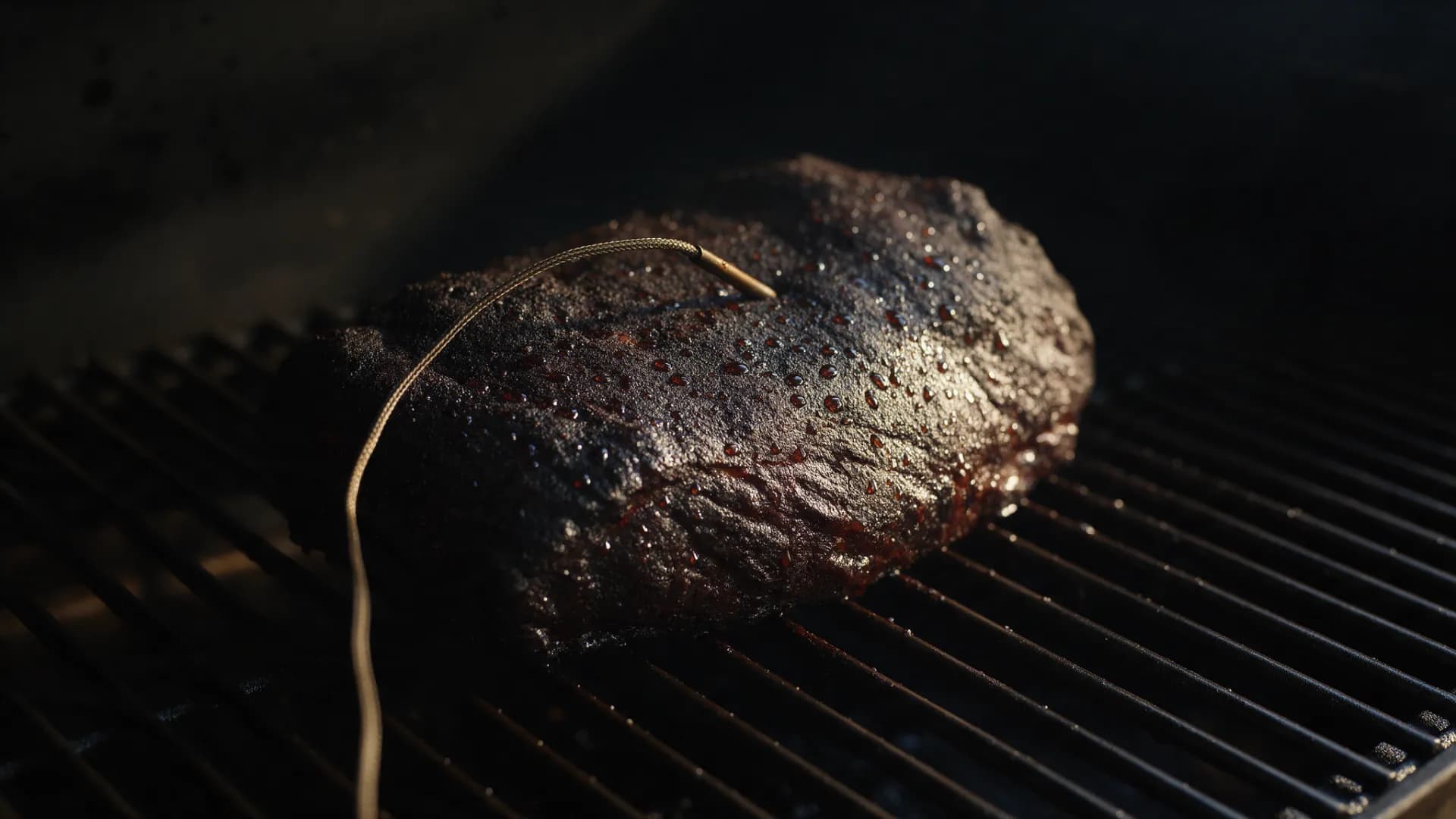
Why your brisket stops climbing
By Tim · 26 October 2026 · 9 min read
Your brisket stops climbing because it's sweating, and that flat stretch is called the stall. Water evaporating off the surface carries heat away. When that cooling matches the heat coming in from the pit, the temperature goes flat. You haven't done anything wrong. It usually happens around 65–77°C (150–170°F) and lasts from about an hour to six hours or more. You can wait, turn the pit up, or wrap.
On this page · 11 sections
Lean probe, °C, one cook on 26 July 2026
- 07:45 Stall: pit 124°C
- 08:13 Pit up: pit 135°C
- 08:26 Pit down: pit 111°C, lean -9°C/hr
- 08:50 Fire sags, lean -28°C/hr
2.1 kg flat-dominant brisket, Hark offset, leave-in probes not calibrated. No readings were logged between 08:13 and 08:54, so the line breaks.
See the readings as a table
| Time | Lean |
|---|---|
| 06:52 | 54.2°C |
| 07:10 | 58.4°C |
| 07:45 | 62.4°C |
| 07:56 | 63.9°C |
| 08:13 | 67.2°C |
| 08:54 | 64°C (after handling) |
| 10:04 | 78.1°C |
| 10:42 | 87.5°C |
| 11:32 | 94.1°C |
The stall is your brisket sweating, and the sweat cools it
The stall is evaporative cooling, the same thing that cools you on a hot day. Lean meat is roughly three-quarters water, so a brisket has plenty to sweat. As it heats, water moves to the surface and evaporates, and evaporating water takes a lot of heat with it. When that cooling roughly matches the heat coming in from the pit, the temperature stops rising.
If you're watching the probe at 2am, it feels like something has broken. It hasn't. The fire is pushing in as much heat as it was an hour ago. The difference is that now just as much is leaving with the water as it evaporates. That's why the probe can sit still for hours, or even dip a little.
Is the stall collagen or fat rendering? No
Two experiments ruled out collagen and fat, and both point to water. In 2011 Greg Blonder put a wet sponge and a lump of pure beef fat in the same 107°C (225°F) smoker. The sponge stalled like a brisket. The fat just kept climbing, and left a pool of rendered fat behind.
The Modernist Cuisine team cooked two briskets side by side in an oven, one open and one vacuum-sealed. The open one stalled. The sealed one couldn't lose water to the air, and it rose steadily with no stall at all. If collagen were the cause, both briskets would have stalled.
There isn't enough collagen to do it anyway. Muscle meat is only about 1–2% collagen, far too little to soak up hours of heat. And if the stall came from something melting, it would hold at the same temperature however hot the pit was (ice sits at 0°C in any oven). The brisket stall moves when the pit moves. Collagen still matters for tenderness, just not for the stall.
Why does the stall end on its own?
The stall ends when the surface dries out faster than water can seep up to it. Water reaches the surface slowly from inside the meat, which is why the cooling lasts hours instead of minutes. Once the surface dries, the cooling can't keep up and the temperature climbs again. In the Modernist Cuisine test, the open brisket broke after about four hours, once its surface had dried.
What decides how long and how low your brisket stalls
Pit temperature, airflow, humidity and a wet surface all move the stall, so there's no single stall temperature. Anything that adds heat shortens it. Anything that speeds up evaporation makes it lower.
| What changes | What it does to the stall | What the tests showed |
|---|---|---|
| Hotter pit | More heat in, so the meat gets through sooner, or barely stalls | In a hot enough oven, Blonder's stall disappeared |
| More airflow | More cooling, so a lower stall | Faster airflow lowered Blonder's stall by up to about 14°C (25°F) |
| More humid air | Slower evaporation, so a higher, often shorter stall | A humid sponge stalled nearly 11°C (20°F) higher and finished about 20% sooner |
| Wet surface (spritz, mop) | Feeds the cooling and can stretch the stall | Blonder's spritz dip was modest and recovered quickly |
Offsets and fan-driven pellet cookers move more air than a sealed electric smoker, so expect the airflow effect on those. Humidity isn't simply "faster", though. In the same sponge tests, the humid oven got to 66°C (150°F) first, but the dry oven got to 93°C (200°F) first.
Early: climbing
The stall: flat
Wrapped: climbing again
Red: heat from the pit. Amber: water leaving, taking heat with it.
What I saw on one cook: the stall moved both ways
On one cook, my brisket's stall followed the pit up and down inside an hour.
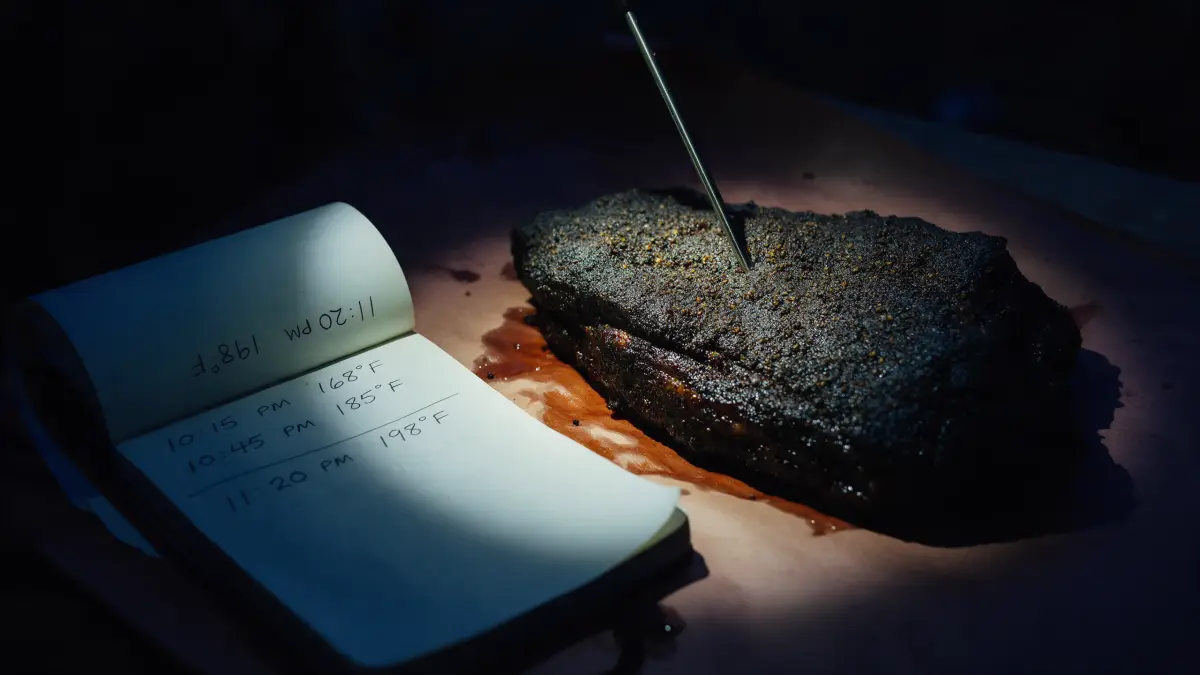
It was July 2026, a 2.1 kg flat-dominant brisket on my Hark offset. The lean (flat) stalled at 62–64°C (144–147°F). My probes haven't been calibrated, so treat that exact number loosely. It sits a little under the usual range, which is one more reason I don't give a fixed stall temperature.
- Pit raised to 135°C (275°F): the lean climbed through at about 11°C (19.8°F) an hour.
- Pit cut back to 111°C (232°F): the stall came straight back, and the lean fell at 9°C (16.2°F) an hour.
- Fire sagged further: the lean was dropping at 28°C (50.4°F) an hour.
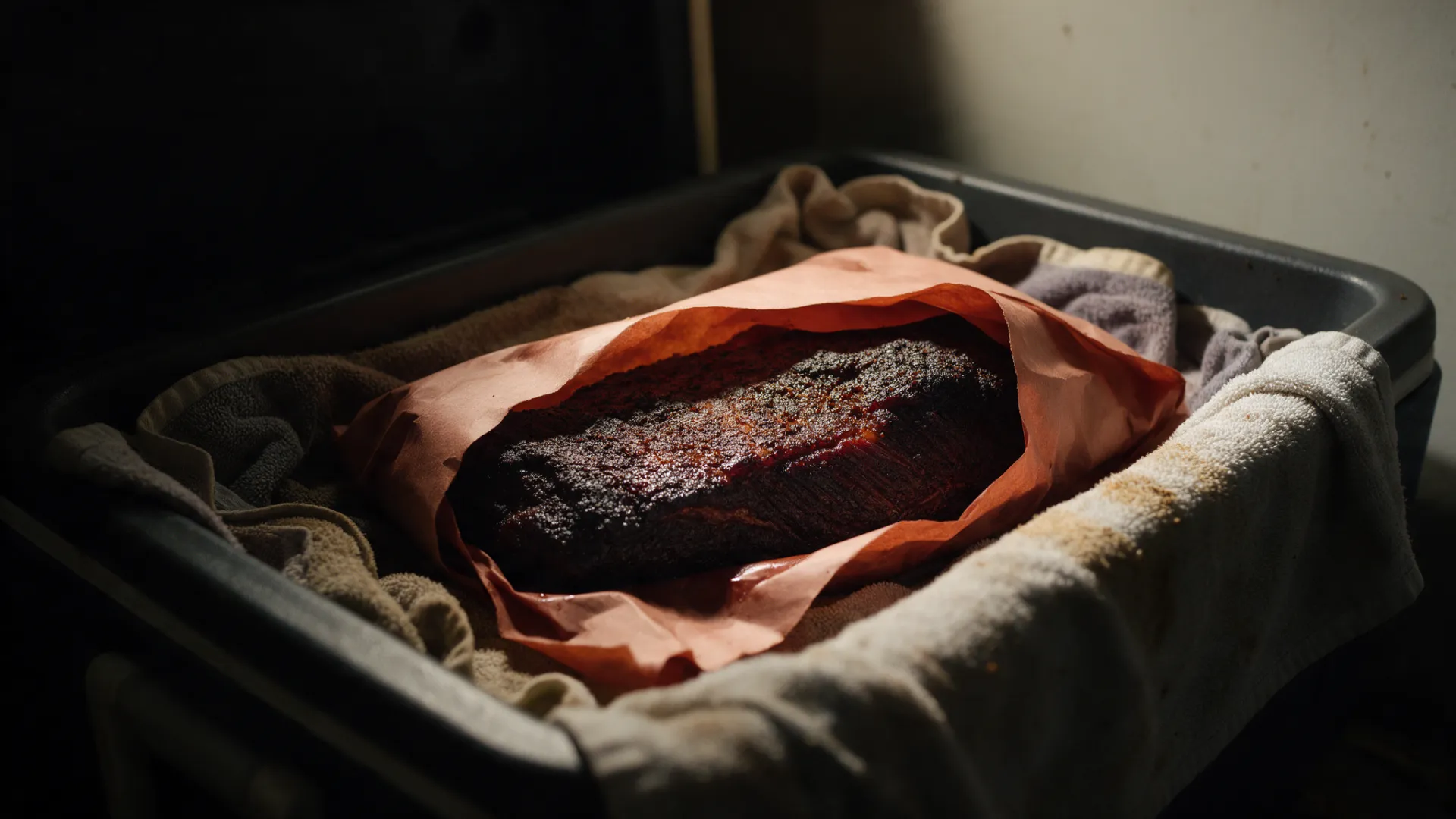
- Wrapped in butcher paper, 3 h 24 min in: the lean climbed again, and I pulled it at 6 h 2 min.
The lean flat also stalled harder than the fattier point, and once it was wrapped, dips in the fire barely mattered. That's one cook, not a rule, but it lines up with the experiments. And every stall I've logged has been cut short by a wrap, so I can't tell you how long one lasts on my pit. For that, the experiments above are the better guide.
Wait, raise the pit or wrap: each way through has a cost
Waiting costs time, raising the pit costs attention, and wrapping costs bark. None of them is wrong. Pick the one that matches what you'd rather keep.
| Choice | What it does | What it costs | Pick it when |
|---|---|---|---|
| Wait it out | The stall ends when the surface dries | Time; on a lean flat, more moisture lost | You want the surface to keep drying and firming, and you have hours spare |
| Turn the pit up | More heat in tips the balance | Fire discipline; a sag can drop the meat back | You're running behind and can watch the fire |
| Wrap | Stops the sweat, so it ends the stall | Softer bark, because moisture is trapped | You'd rather have time than bark |
Wrapping saves real time. In Blonder's test with two 1.4 kg (3 lb) pork shoulders at 110°C (230°F), wrapped was tender in about 10 hours, unwrapped took almost 14.
The tighter the wrap, the less sweat gets out. Under wraps in a 121°C (250°F) oven, water held at 77°C (170°F) bare, 86°C (187°F) under one layer of kraft paper, 88°C (190°F) under two, and about 100°C (213°F) under foil or parchment. Paper slows the sweat; foil stops it. A leak in either lets evaporation start again, which is how a brisket can stall twice.
The scientists wrap too. One Australian-and-US study wrapped every brisket in foil at 66°C (151°F) on a 121°C (250°F) pellet smoker, and they were done at 93°C (199°F) in 6.0–7.9 hours. Those were 4–5 kg briskets, so the times aren't a promise for yours.
Is a long stall a food-safety problem?
Usually not in itself, because most stalls sit above the 5–60°C (41–140°F) danger zone, but don't assume every stall is safe. The meat has to get through the danger zone on the way up. On my one cook, the brisket was past 60°C (140°F) about two hours in, so the stall began above 60°C.
Some plateaus show up lower. If your meat looks stuck below 60°C, that isn't the usual stall, and it isn't something to sit in for hours. COMPLIANCE? The "40 to 140°F in 4 hours" rule on forums is American lore, not an Australian standard.
What to do at your pit
- Check the fire before you touch the meat. A flat or falling probe during the stall is usually the balance tipping, not the brisket going wrong. If the pit has sagged, fix the fire first.
- Don't chase a number. Expect the stall somewhere around 65–77°C (150–170°F), and don't panic if yours is a few degrees either side.
- Decide what you'd rather keep: time or bark. Lots of time and you love a firm surface? Wait. Running late? Turn the pit up or wrap.
- Wrap tight if speed matters most. Foil stops the sweat; butcher paper slows it and keeps more bark. Seal it well, because a leak can restart the stall.
- Go easy on the spritz. Every spritz puts water back on the surface for the stall to feed on (spritzing has its own page).
- Leave the pit after the wrap, not during the stall. On my one cook, a fire dip during the stall dropped the meat backwards. After the wrap, a dip barely mattered.
- Build in a buffer and plan the hold. If you finish early, hold the meat at 60°C (140°F) or hotter.
Questions people ask
At what temperature does brisket stall?
Usually somewhere around 65–77°C (150–170°F) internal, but there's no fixed number. The stall is evaporative cooling, so it moves with your pit temperature, airflow and humidity. In one well-known experiment, a brisket in a 107°C (225°F) smoker stalled at about 67°C (153°F) for almost six hours. More airflow and drier air tend to make it stall lower.
How long does the brisket stall last?
Anywhere from about an hour to six hours or more, and nobody can promise you a number. It lasts until the meat's surface dries enough that evaporation can't cancel out the heat from the pit. A hotter pit or a wrap shortens it; regular spritzing can stretch it.
Why did my brisket's temperature drop during the stall?
Because the meat is losing more heat to evaporation than it's getting from the fire. In the stall the two are balanced, so any dip in pit temperature, or a spritz of cold liquid, tips it into a small loss. Check the fire first. If you want the balance gone for good, wrap, so there's nothing left to evaporate.
Is the brisket stall caused by collagen or fat rendering?
No. Both happen during a long cook, but neither causes the stall. In one test, a wet sponge stalled like a brisket while a lump of beef fat in the same smoker kept heating. In another, a vacuum-sealed brisket didn't stall at all while its unwrapped twin did. Muscle is only about 1–2% collagen, far too little to soak up hours of heat. The cause is water evaporating from the surface.
Should I wrap brisket to get through the stall?
Wrap if you'd rather have time than bark. Wrapping stops most of the evaporation, so the stall ends and the cook speeds up; in one test, wrapping cut about four hours off a pork shoulder. Foil stops evaporation almost completely. Butcher paper lets some through, so paper softens the bark less but saves less time. Researchers smoking briskets for one study wrapped at 66°C (151°F).
Read next
 Why low and slow workswhat the hours after the stall are actually doing to the meat.
 Butcher paper vs foil vs nakedthe wrap, in detail.
 Resting and holding a brisketwhat to do when it finishes early.
For the curious
The plain words above stand in for three technical ideas. Evaporative cooling is the stall itself. Latent heat of vaporisation is the energy water soaks up to become vapour. Wet-bulb temperature is what a thermometer reads with a wet sock on it: a fully wet surface sits at about the wet-bulb and can't climb past it until it dries. A brisket stalls well above a typical smoker's calculated wet-bulb, because water reaches its surface slowly, so don't read it as "the meat stalls at the wet-bulb".
- Greg Blonder, 2011, BBQ stall explained: the sponge-and-fat test, airflow, the wrapped pork shoulders.
- Modernist Cuisine, 2012, The barbecue stall: open versus vacuum-sealed briskets, with wet-bulb logged.
- Blonder, 2012, Melting fat during cooking: muscle is only about 1–2% collagen.
- Blonder, 2014, Sweating it out: humidity moves the stall.
- Blonder, 2011, Foiled and basting: paper versus foil under a wrap.
- Johnston and colleagues, 2024, Meat and Muscle Biology: researchers wrapping Australian and US briskets at 66°C.
- Sindelar and colleagues, 2020, University of Wisconsin–Madison: the wet-surface rule in a meat plant.
If you're between Rockhampton and Bundaberg and would rather someone else watched the probe at your next event, that's what I do. Get a rough price →