Resting and holding a brisket: what happens after it leaves the pit
By Tim · 27 October 2026 · 11 min read · Last reviewed 28 October 2026
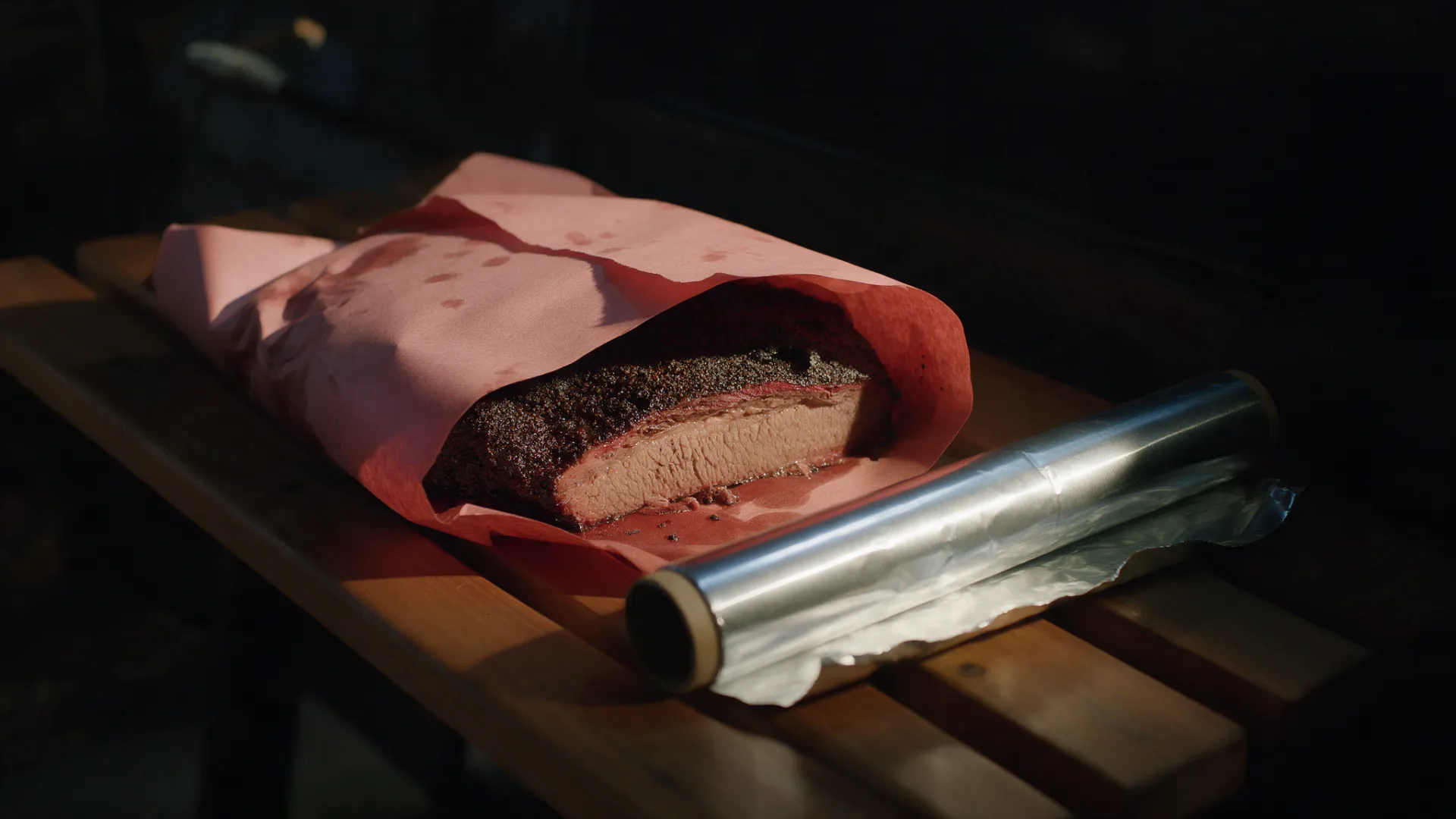
A brisket barely keeps cooking once it's off a low and slow pit, about 2°C on one of my cooks. So rest it wrapped for an hour or two so it slices well. If it has to wait longer, keep the meat at 60°C (140°F) or hotter and check it with a probe. Once it drops below that you've got 4 hours in total.
On this page · 11 sections
Brisket centre, °C, one hold on 26 July 2026
- Lean
- Point
- Meat, approx.
- Where the lean was heading
- 11:32: About 2°C of carryover in the 8 minutes from the probe decision to the oven door, both muscles.
- 13:34: A probe in the oven air reads 57.2°C, under the line. It was meant to be 63–65°C.
- After 13:34: Oven turned up too far: the meat sat about 72.4°C for over two hours, maybe more, and came out dry (approx.: no timed readings).
- 14:40: Where the lean was heading: 60°C about 14:40 if the oven had stayed put.
Shaded: under 60°C, where the 4-hour clock runs. 2.1 kg flat-dominant brisket wrapped in butcher paper, in a benchtop oven; probes not calibrated. Hours along the bottom.
See the readings as a table
| Time | Lean | Point |
|---|---|---|
| 11:24 | 92.3°C | 91.8°C |
| 11:32 | 94.1°C | 92.8°C |
| 12:12 | 86.7°C | 89.9°C |
| 13:12 | 74.7°C | 78.2°C |
Cooling, °C an hour: lean −11.1 (11:32–12:12), then −12.0 (12:12–13:12); point −4.4 (11:32–12:12), then −11.7 (12:12–13:12). After the oven went up, no timed readings: the meat sat about 72.4°C for over two hours.
Does brisket keep cooking after you take it off?
A little, but a lot less than a steak. Pull a thick steak off a hot grill and it can go up another 6–8°C while it sits. That's carryover, the heat in the hot outside layer still moving into the middle. After hours on a gentle pit though, the outside and the middle of a brisket have pretty much caught up with each other, so there's not much heat left to move in. Greg Blonder measured it on a brisket flat and called carryover at the end of a long slow cook "rare to non-existent".
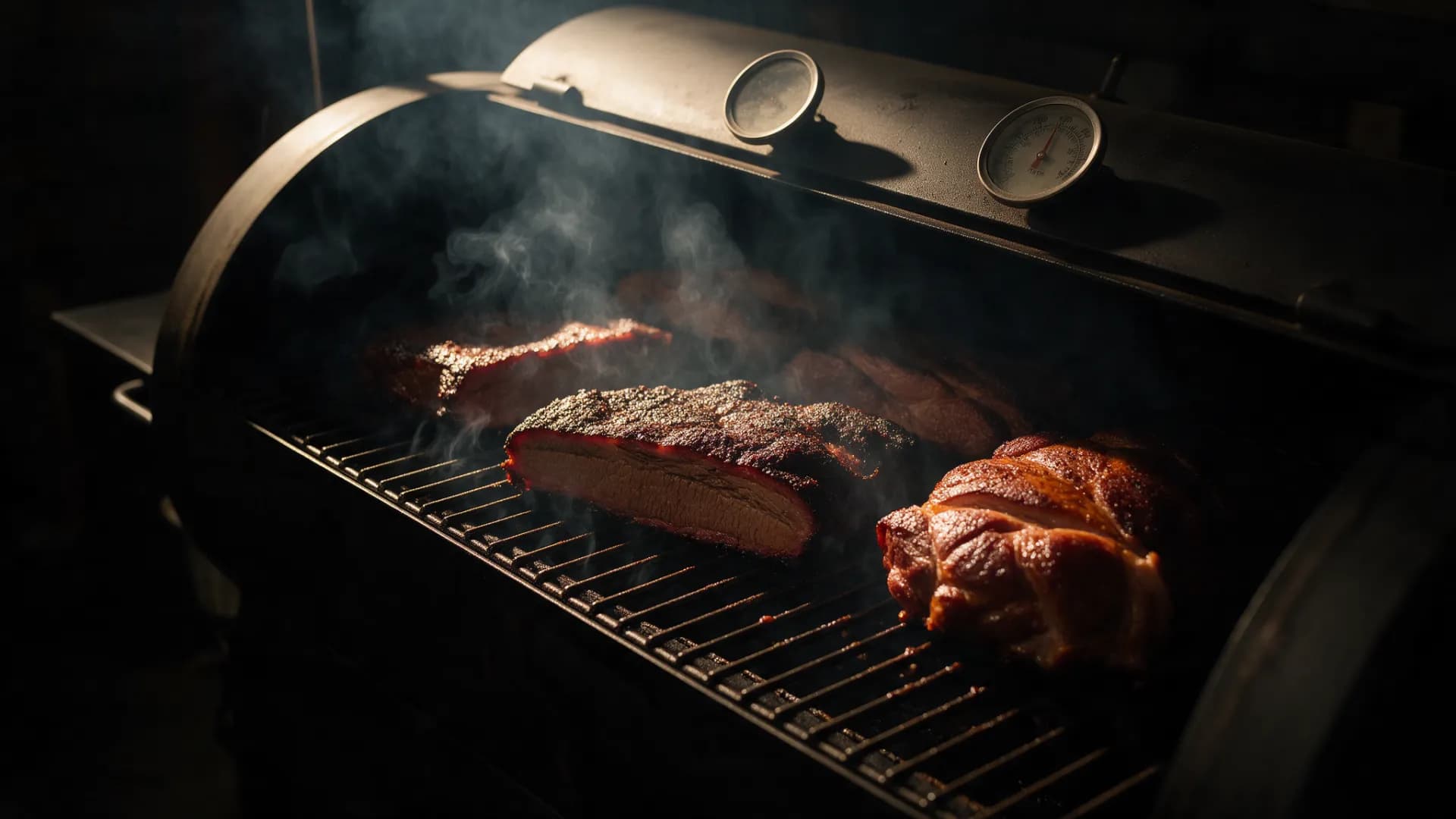
On my 26 July brisket the pit was running hot at the finish, 135–138°C (275–280°F). In the 8 minutes between deciding it was done and getting it to the oven door both muscles went up about 2°C. A hotter pit leaves a bigger gap between the outside and the middle, so off a cooler pit you'd expect even less. Which means you can pull it when it's done (how to tell it's done) and not stress about it overshooting. The "5 to 10°F" (about 3–6°C) you see on American sites hasn't got a measurement behind it that I could find.
So why rest it at all?
Mostly so it slices well. As the juice cools a little it thickens up, because it's full of gelatin and fat, so probably more of it stays in the slice instead of running across the board. That's America's Test Kitchen's reasoning and nobody's tested it on brisket.
Whether resting actually saves juice is honestly disputed. The test kitchen got 60% less juice on the board from a pork loin rested 10 minutes. Blonder found resting mostly changes when the juice comes out, and once he poured the board juice back over the slices the totals were close. Neither of them cooked a brisket.
The other reason is timing. A rest gives you a buffer, so the brisket can finish a bit early. Aaron Franklin rests his fully wrapped until the middle comes down to about 60–63°C (140–145°F), which he says takes 1 to 2 hours depending on the weather. Even the researchers who smoked Australian briskets for a 2024 study rested them at least 30 minutes in an insulated box before slicing.
Though a wrapped rest does steam the bark a bit. If you want it crisp, Blonder's advice is to slice straight away.
A hold is still cooking
While the brisket's hot it's still cooking. In 2025 a Texas A&M team smoked 96 briskets and held some of them for 3 hours at the temperature they finished at. The held ones came out more tender every time, and lost meat every time, between about 3 and 11 percentage points of yield. At normal finishing temps of 85–90°C (185–194°F) that was about 3 to 4 points, or about 200 g less meat off a 5 kg trimmed brisket. The ones finished at 90°C and held 3 hours fell apart when they were hung over an edge. That hold was a commercial smokehouse kept at temperature though, which isn't the same as an esky slowly cooling down.
| Finished at | Yield, no hold | Yield, 3 h hold | Meat the hold cost | More tender with the hold? |
|---|---|---|---|---|
| 75°C (167°F) | 72.9% | 62.2% | 10.7 points | ✓ Yes |
| 80°C (176°F) | 64.8% | 61.4% | 3.4 points | ✓ Yes |
| 85°C (185°F) | 63.2% | 59.2% | 4.0 points | ✓ Yes |
| 90°C (194°F) | 58.4% | 55.7% | 2.7 points | ✓ Yes |
If there's still a touch of resistance that's ok if you are long holding as the collagen conversion continues to happen as the brisket's internal temp falls to the holding temp. I've watched several YouTube videos that explain that Goldee's in Texas (and others) pull at 87°C (189°F) and hold for 24 hours, so that final collagen conversion occurs over the 24 hour hold period.
The hotter and longer it sits, the more it softens and the more juice it gives up. That's why I think a fatty packer can take a long hold far better than a lean flat. My February birthday packer, 4.7 kg, sat in a holding oven for a few hours and came out nice and soft. The two muscles don't cool the same either. On 26 July the lean dropped about 11°C an hour while the point only lost about 4°C an hour for the first 40 minutes, before both fell at about 12°C an hour. So on that cook the point held its heat longer, and a hold gives the point more extra cooking than the flat.
The hold that went wrong both ways
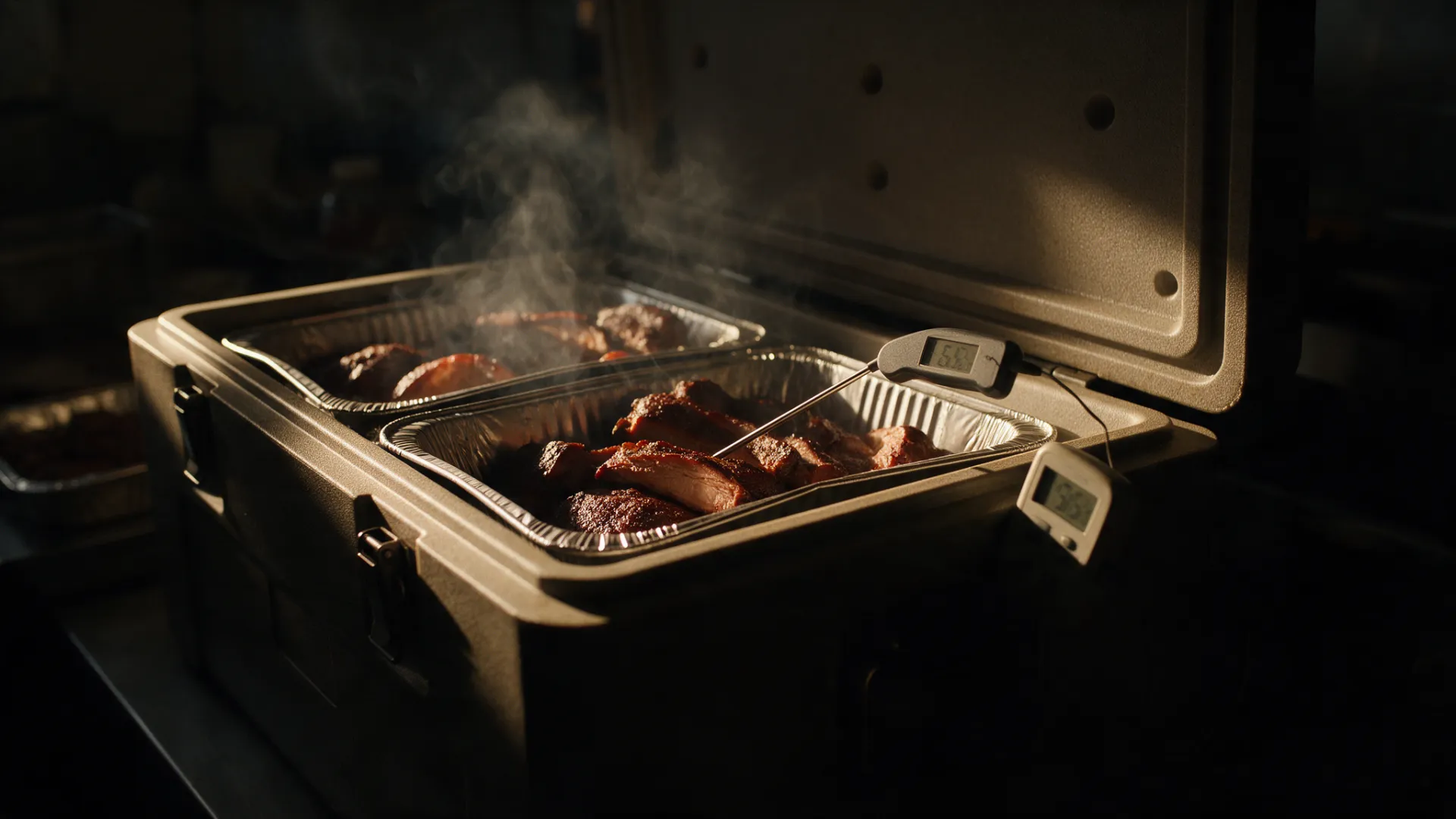
My 26 July cook was an experiment with a benchtop oven as a holding box. It was a 2.1 kg flat-dominant brisket, wrapped in butcher paper, off the pit at 11:32 with dinner at 5. The oven was meant to sit at 63–65°C (145–149°F) and its dial said it was there.
But the lean was dropping 11 to 12°C an hour, which is way too fast for meat sitting in a 63°C oven. So at 13:34 I put a probe in the oven air and it read 57.2°C (135.0°F), under the 60°C line. The dial on that oven starts at 50°C so 60 is right down the bottom of it. The meat turned out to be the better thermometer. I turned the oven up before the lean was due to reach 60°C, which would have been around 14:40.
Then I overdid the fix. The oven went up too far and the brisket sat at 72.4°C (162.3°F) for over two hours, maybe more. It came out dry and a bit chewy and all three of us eating it said so. It was injected and lean and I'd changed the rub as well, so I can't pin it all on the hold, but the hold's my prime suspect. What I wrote in the log was "Safe and correct are not the same target."
I set the hold oven to 65°C (149°F) and slice to order so it stays hot and juicy. It's the meat I check though, with a probe, never the dial. If you're not sure your probe reads true, where to put the probe covers checking it.
How long can a brisket sit in an esky?
Nobody's measured it, me included, so I won't give you a number. It depends on the esky, the towels, the weather and how big the brisket is.
An esky doesn't keep anything hot. It's like putting a lid on a bath, it only slows down how fast it goes cold. Lie in it a while and it's lovely, leave it all night and you're sitting in lukewarm water, which is just where bacteria like it. The one to worry about with big slow-cooled pieces of meat is Clostridium perfringens. Its spores survive cooking, and Queensland Health says it grows fastest around 43–47°C (109–117°F).
The meat on its way down, °C
Still cooking: softer, but losing juice. Less of both as it cools; there’s no line where it stops.
Holding: the meat at 60°C and up. No time limit, only a quality one.
43–47°C: where C. perfringens grows fastest.
Below 60°C: the 4-hour clock. 4 hours in total from the moment it drops under, then eat it or bin it (FSANZ).
Fatty packer: a slow fall is fine.
Lean flat: get it down to holding temperature, or serve.
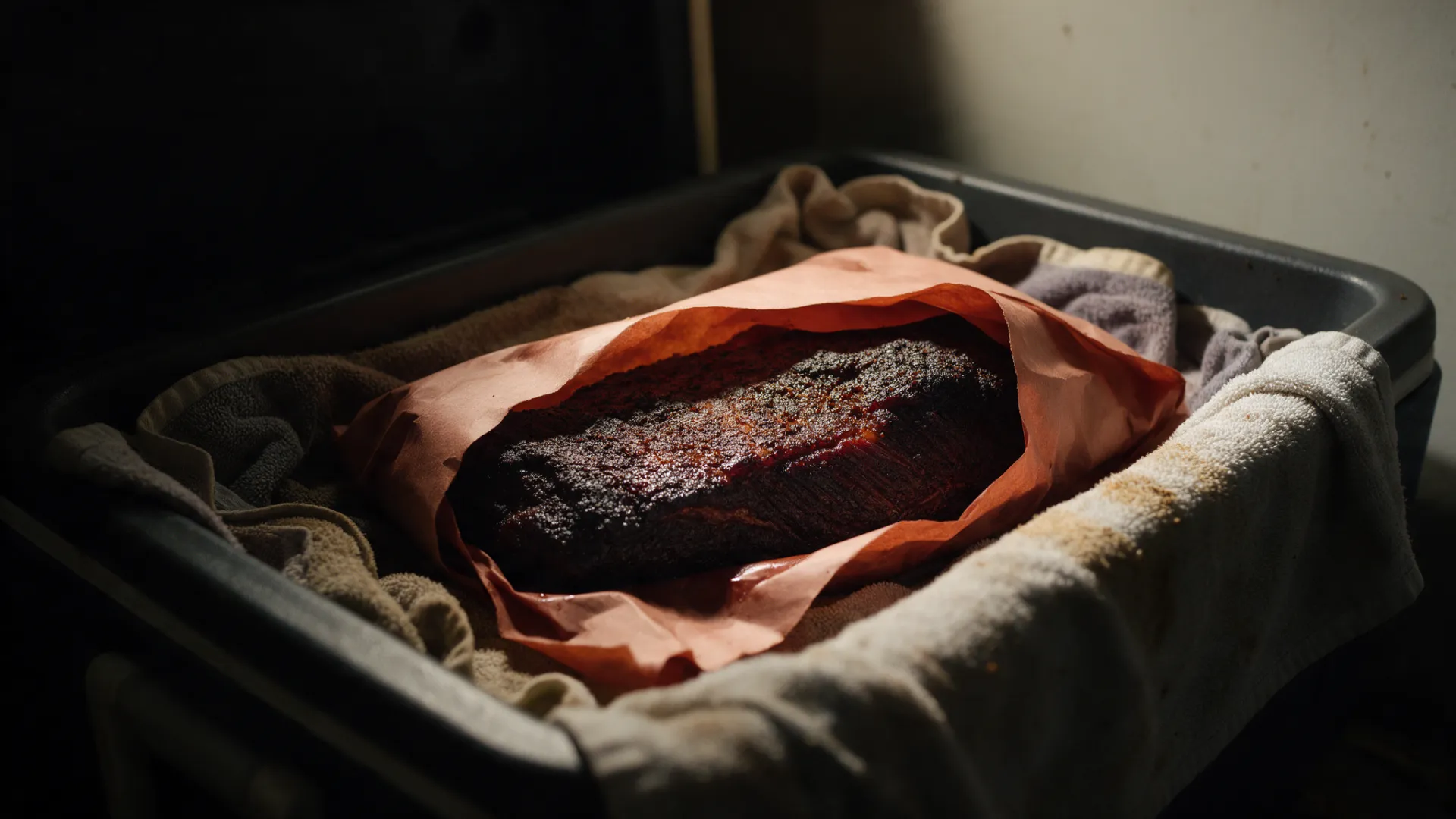
Pre-warm the esky and fill the gaps with towels and it'll cool slower. A big brisket cools slower than a small one. My July 2025 baseline brisket rested an hour and a half wrapped in a towel in an esky and scored 5 out of 5, but I didn't take its temperature during the rest. So leave a probe in the meat. While it reads 60°C or more you're holding, and once it goes under you start counting.
Finished hours early?
On a lean cut it can be better to cool it down on purpose and reheat it than to hold it hot for hours. I did that with a 1.7 kg bone-in mutton leg in August instead of putting it in an esky. It came off the pit at 89.2°C (192.6°F) and I took it out of its hot stock, because two smaller things lose heat a lot faster than one big one. It cooled on the bench at about 20°C an hour, then I wrapped it again to coast down to about 45–55°C. Then it went into a 130°C (266°F) oven until it was back to 70–75°C (158–167°F) and I carved it with hot jus. Crazily soft. That's mutton and it's one cook, and the time it spent under 60°C was well inside the 4 hours, which is the bit to watch if you try it.
Cooking the day before is a different thing. In that 2024 study, people scored brisket served the day it was cooked higher on everything than brisket chilled for a week and reheated. Juiciness had the biggest gap, 59.4 against 53.8 out of 100. They didn't test overnight. If you have to cook ahead, slice or portion it, get it in the fridge fast and reheat it until the middle hits 75°C (167°F).
Leftovers
With leftovers I'll often rewarm them in a bath of gravy and make up sandwiches. Or I'll put the leftovers on a pizza, make a pasta dish or sometimes just eat it cold!
Just don't leave them sitting out. About 30 to 60 minutes is about right for me, it can get contaminated pretty quickly. The official rule gives you a bit longer, it's in the box below. Slice it or cut it into smaller pieces in shallow containers before it goes in the fridge, because a whole brisket cools far too slowly. Food safety in low and slow goes into cooling properly.
At your pit next time
- Pull it when it's done. Expect it to go up only a couple of degrees.
- Rest it wrapped for an hour or two before you slice.
- If it has to wait longer, leave a probe in the meat and keep it at 60°C or above.
- Check the hold oven's air and the meat with a probe, never the dial.
- A lean flat that's finished hours early might be better cooled and reheated than held hot.
- Get leftovers into shallow containers and into the fridge quickly.
Quick answers
How long should you rest a brisket?
Usually one to two hours, wrapped, which is long enough to slice cleanly and still serve it hot. Aaron Franklin rests his until the centre comes down to about 60–63°C (140–145°F), which he says takes one to two hours depending on the weather. You're not waiting for carryover, because a brisket barely climbs after a long cook. If it has to wait longer, keep the meat at 60°C or hotter.
How long can you hold a brisket in an esky (cooler)?
As long as the meat stays at 60°C (140°F) or hotter, and that depends on the esky, the towels, the weather and the size of the brisket. An esky doesn't keep food hot, it only slows the cooling, so leave a probe in the meat. Once the centre drops below 60°C, Australian food-safety guidance gives it up to four hours in total before it has to be eaten or thrown out.
Does brisket keep cooking after you take it off the smoker?
A little, but less than most guides say. Carryover comes from a hot outer layer pushing heat into the middle, and after hours of slow cooking a brisket's outside and centre are already close. Greg Blonder found it rare at the end of a long, slow cook, and on one of my cooks it was about 2°C. It does keep softening while it stays hot.
Is it safe to hold brisket at 60°C for hours?
Yes, as long as the meat itself stays at 60°C (140°F) or hotter. Australian food rules don't set a time limit for hot-held food above 60°C, but quality drops, because a long hot hold keeps cooking the brisket and costs juice and weight. The real risk is a hold that drifts under 60°C without anyone noticing, so check the meat with a probe rather than trusting the oven dial.
Can I smoke a brisket the day before and reheat it?
You can, but it's rarely as good. In a 2024 study of Australian and US briskets, people scored brisket served the day it was cooked higher on every count than brisket chilled and reheated a week later. If you have to, slice or portion it, get it in the fridge within two hours and reheat it until the centre reaches 75°C (167°F). Eat leftovers within two to three days.
For the curious
The heat that keeps moving inward after meat comes off is carryover cooking, and keeping cooked food hot until it's served is hot holding. Barbecue cooks call a towel-lined esky a faux cambro, after the insulated boxes caterers use. FSANZ's 4-hour allowance for hot food that's dropped below 60°C is called using time as a control.
Blonder's measurements are on his carryover and resting meat pages. The 96-brisket hold study is Kerth et al. 2025, and the same-day versus reheated study, which used Australian and US briskets, is Johnston et al. 2024. The Australian rules are on FSANZ's temperature control page, and the bacteria are on Queensland Health's Clostridium perfringens fact sheet. Franklin's rest is in Franklin Barbecue: A Meat-Smoking Manifesto (2015).
If you're between Rockhampton and Bundaberg and would rather someone else held the brisket for your next event, that's what I do. Get a rough price →