
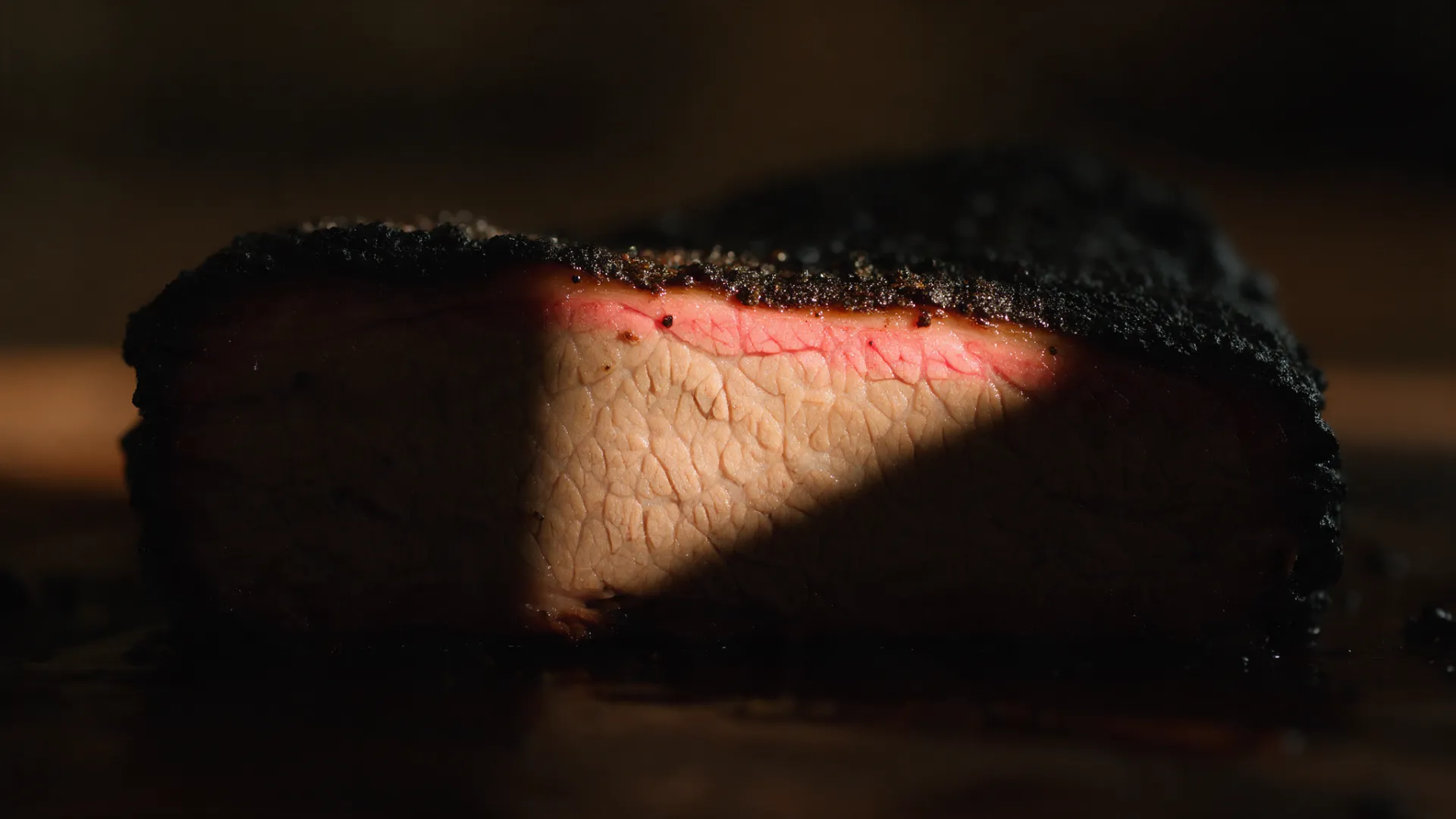
The smoke ring: what it is, and why it isn't flavour
By Tim · 28 October 2026 · 10 min read
The smoke ring is the meat's own red pigment, myoglobin, locked pink by a trace of nitrogen gas from the fire. It's the same pink as ham. It forms early in the cook and only near the surface, and the smoky taste comes from somewhere else. Pink doesn't tell you whether the meat is cooked either.
On this page · 10 sections
- A trace of nitrogen gas goes a few millimetres to about a centimetre into the meat and turns that band pink: colour.
- Smoky compounds from the wood stop at the crust: flavour.
You can have one without the other
Gas oven, curing salt → ring, no smoke
Electric smoker → smoke, little ring
A drawing, not a measured slice. The dashed line is the pink band.
What is the pink band, then?
It's the meat's own colour. Raw beef is red because of a pigment called myoglobin, and when you cook it that pigment normally goes grey-brown. But a fire gives off a tiny bit of nitrogen gas, and if that gets to the myoglobin first it locks it pink. Heat it after that and it stays pink. Which is the same thing that happens in ham, bacon and corned beef, only there it's done with curing salt instead of a fire.
So nothing has soaked in and dyed the meat. It isn't the rub either. Greg Blonder, who ran a long series of smoke ring tests on his own smokers between 2011 and 2014, checked paprika and it doesn't colour the ring.
Which gas does the work is still argued about. Harold McGee and the American Meat Science Association think it's nitrogen dioxide from the fire, dissolving into the wet surface and turning into nitric oxide there. Blonder got a deep ring by blowing bottled nitric oxide over meat with no smoke at all, so his view is that nitric oxide goes straight in. Both end at the same pink pigment, and honestly for your cook it doesn't matter which.
It takes hardly any. Cornforth and his team looked at gas ovens in 1998 and found under half a part per million of nitrogen dioxide was enough to pink turkey. Beef pinked above about 2.5 parts per million.
Why the ring is only a few millimetres deep
A smoke ring is usually somewhere from a few millimetres to about a centimetre deep. McGee puts it at up to about a centimetre, 8–10 mm. It stays shallow because the gas has to soak in from the outside, and soaking slows down the further in it goes. Going twice as deep takes about four times as long. So most of the ring gets made early.
Then it stops growing once the outside of the meat gets hot enough to turn the pigment grey. In beef that's around 60–70°C (140–158°F), give or take. Once the outer layer gets there the ring is fixed at whatever depth it has reached.
That's the bit the old "no ring forms after 60°C" rule gets wrong. Your probe is in the middle of the brisket, but the ring is on the outside and the outside heats on its own schedule. A wet surface stays cooler for longer because it's sweating, so it keeps building ring. A dry surface on a hot start sets it early. In Blonder's tests the mopped pork got the strongest rings of the lot.
What makes a ring bigger or smaller
In Blonder's tests and advice the ring comes out deeper with meat straight from the fridge, a wet surface, a gentle start and a real wood or charcoal fire burning with plenty of air. Cold from the fridge is where the meat should be anyway until it goes on, so that one's easy.
Fat shrinks it. Fat has no myoglobin and the gas can't get through it, so about 12 mm of fat can hide a 6 mm ring. Acid on the surface early shrinks it too, and his vinegar brine cut the ring about three-fold. A lot of salt and a hot, fast start both make it thinner. Salt and injections have their own articles (dry brining and does injecting work?).
The meat matters. Beef rings more than pork, and chicken breast hardly rings at all, because hard-working dark muscle has several times more myoglobin in it.
The fuel matters more than the wood species. Blonder measured the nitric oxide coming out of the exhaust of different smokers. Roaring wood fires and charcoal briquettes gave 50–200 parts per million, pellet smokers 25–50, and electric smokers and gas grills under 2. That's nitric oxide, mind. Gas burners pink meat through nitrogen dioxide instead, which is why gas barbecues still do it (more on that below). An electric smoker smoulders its wood too cool to make much of the gas, which is why they rarely give a ring. Wood is only about 0.2% nitrogen anyway, and nobody has shown any wood gives a better ring, the ironbark I burn included.
Is the smoke ring where the flavour is?
No. The ring and the smoky taste come from two different parts of the fire. The ring is that trace of nitrogen gas. The flavour comes from compounds that come off the wood itself as it breaks down, things like guaiacol (clean smoke goes into those). In a normal cook they arrive together, so it's easy to think one is the other. But you can get each one on its own.
You can get a ring with no smoke. Blonder's bottled gas did it, and so do gas ovens, gas barbecues and curing salt. He even smoked a cold brisket for just 15 minutes, finished it in an electric oven, and it still had a ring.
You can get smoke with no ring too. Electric smokers give smoky meat with little or no ring. Jeff Savell at Texas A&M told Texas Monthly in 2016 that a sawdust-fed smokehouse, the kind used commercially, does the same. And Aaron Franklin and Jordan Mackay say in their 2015 book that Franklin's own barbecue "doesn't always" have the classic pink ring.
The flavour mostly lives in the crust. When Blonder tasted a pork butt slice by slice, only the top half-centimetre or so was clearly smoky, and just inside the ring it was only faintly smoky. That's one tasting on his own palate, but it fits with everything else.
My July 2025 baseline brisket is the best example I've got. It was a 1.7 kg flat, it scored 5 out of 5, everyone was happy with it and the smoke was if anything a touch strong. My note afterwards says "Smoke ring not fully visible but flavour was there, maybe a touch strong." Great brisket, smoky brisket, hardly any ring. That's one cook, and I can think of a few reasons the ring was faint. It got hot fast in the first hour, 7°C to 40°C (45°F to 104°F) inside. It had a 13-hour dry brine. The binder was Worcestershire, which has vinegar in it. I'd also left 6 mm of fat on. I never tested which one did it and it might be all of them.
Pink ribs with no wood at all
In August I did baby back ribs on the gas Weber Q with no wood and no smoke. I'd blocked three of the vents with foil to hold it at 107°C (225°F). They came out pink right through, like ham, and someone at my table asked about it. They were cooked, soft and probed.
The pink went right through instead of sitting in a ring because those racks were thin, about 550 g each, so the gas got all the way to the middle. Smoked burger patties do the same thing. When Cornforth looked at gas ovens he traced the pinking to nitrogen dioxide from the burner, and at the levels he tested, carbon monoxide and nitric oxide on their own didn't pink the meat. I did wonder whether choking the vents made more of it. Not tested, and Blonder found less nitric oxide with less air on his wood fires, so I wouldn't bet on it. If you're cooking for someone who'd rather skip the smoke, BBQ for people who don't love smoke has the guest side of this.
Is pink smoked meat undercooked?
Not because it's pink. Colour depends on the pigment, how acidic the meat is and the gases around it, so it can't tell you whether meat is cooked. A smoke ring stays pink in fully cooked meat, and US food-safety guidance says smoked meat can keep a pink rim about a centimetre wide even when it's done. Slow-cooked meat can also stay a bit pink in the middle, separate from any ring, because the pigment hangs on longer when it's heated gently.
It goes the other way too. Meat can go brown before it's safe, which meat scientists call premature browning. The American Meat Science Association's 2023 colour guidelines say cooked colour "is not necessarily a reliable indicator" of doneness. The only way to know is a thermometer in the thickest part (where to put the probe).
At your pit next time
- Don't chase the ring. If the brisket tastes right, the ring was never the point.
- If you'd like one anyway, put the meat on straight from the fridge and keep the surface damp early.
- Run a lively fire on real wood or charcoal with plenty of air.
- Trim the fat thin on the face you want the ring on.
- Leave acidic binders and sprays until after the first hour or so if the ring matters to you.
- On an electric smoker expect little or no ring. The smoke flavour can still be there.
- Check doneness with a probe in the thickest part, never by the colour of the slice.
Quick answers
Does the smoke ring add flavour?
No. The smoke ring is the meat's own red pigment, locked pink by a trace of nitrogen gas from the fire. Smoke flavour comes from different compounds released as the wood breaks down, and it sits mostly in the outer crust. You can get a ring with no smoke at all, from a gas oven or curing salt, and smoke flavour with no ring from an electric smoker, so the two aren't tied together.
Why didn't my brisket get a smoke ring?
Usually because the outside heated up before much gas could soak in. A ring forms early, while the surface is still cool and damp, so meat that went on warm, a hot start, a dry surface, a thick fat cap or an acidic binder can all keep it thin. The fuel matters too, because electric smokers make very little of the gas. A faint ring doesn't mean the brisket will taste less smoky.
Is pink smoked meat undercooked?
Not necessarily, and brown meat isn't necessarily cooked either. Colour depends on the meat's pigment, its acidity and the gases around it, so it can't tell you doneness, and a smoke ring stays pink in fully cooked meat. Use a thermometer in the thickest part. In Australia that's 75°C (167°F) for poultry, mince, sausages and rolled or injected meat, 70°C (158°F) for pork, and 63°C (145°F) plus a rest for whole beef and lamb.
Do electric and pellet smokers make a smoke ring?
Electric smokers rarely do. Their wood smoulders too cool to make much of the nitrogen gas that forms the ring, though the meat can still taste smoky. In one experimenter's measurements, pellet smokers made well under half as much of the gas as a roaring wood fire or charcoal briquettes.
Can you fake a smoke ring?
Yes. Curing salt, the nitrite used to make ham and bacon, turns the outer layer of meat the same pink without any smoke, which is one reason a ring proves very little. Curing salt is a regulated preservative used mainly to stop botulism in cured meats, so it's measured carefully for curing and never sprinkled on for colour. A faked ring adds nothing to the smoke flavour either.
For the curious
The pink is nitrosylhemochrome, the cured-meat pigment: myoglobin that has picked up nitric oxide (NO) and then been heated. Whether the NO arrives directly or as nitrogen dioxide (NO₂) dissolving into the wet surface is the open question. McGee's On Food and Cooking (2004) and the AMSA meat colour guidelines (King et al. 2023) take the NO₂ route, and Cornforth et al. 1998 traced gas-oven pinking to NO₂. Blonder's Atlas of the Smoke Ring makes the case for NO with bottled gas, and it's where the fat, moisture, fuel and tasting tests are. Depth grows by diffusion, roughly with the square root of time. Meat that browns before it's safe is premature browning (King & Whyte 2006; USDA FSIS, The Color of Meat and Poultry). Savell's sawdust-smokehouse point is in Daniel Vaughn's Texas Monthly piece. The Franklin line is from Franklin Barbecue: A Meat-Smoking Manifesto (2015), p.145. Australian temperatures are from Safe Food Queensland and the Food Safety Information Council. The US poultry figure is 74°C (165°F).
Read next
 Clean smoke: thin blue vs thick whitewhere the smoke flavour actually comes from.
 Dry briningwhat salt does to the surface, ring included.
 Where to put the probethe test that colour can't give you.
If you're between Rockhampton and Bundaberg and would rather someone else stood at the pit for your next event, that's what I do. Get a rough price →