Beef short ribs: which cut to ask your butcher for
By Tim · 28 October 2026 · 8 min read
Ask for short ribs, three bones from the middle of the rib cage (ribs 6 to 8, or 5 to 8), cut long along the bone with the thick meat left on top. Chuck short ribs are the cheaper option. Then smoke them unwrapped at about 135°C until a probe slides in like butter.
On this page · 11 sections
US (USDA IMPS)
Australia (AUS-MEAT)
- US, red: plate short ribs, IMPS 123A: ribs 6–8 from the plate, bones about 20–30 cm. Chuck short ribs (IMPS 130) are ribs 2–5.
- AUS-MEAT, red: short ribs, 1686–1694: the band between the rib set and the brisket, about 75 mm out from the rib-eye, rib numbers agreed with the butcher. The brisket runs back to the 13th rib.
- Both, amber: the thick meat (serratus ventralis), over ribs 5–8.
Schematic, not to scale. Front of the animal on the left, backbone at the top.
Why the label won't tell you
Short ribs at an Australian shop can be almost anything. One butcher online sells an 8-rib rack trimmed into pieces of about 250 g each as short ribs, another sells 1.5–1.8 kg packs under the same name. A Woolworths label says they're cut from the ribs underneath the brisket and that's all. None of them say which ribs. Some people online who asked their butcher for the US code got asked which rib numbers they wanted instead.
So don't go by the name. Go in knowing which bones and how much meat you want.
The meat on top is what you're buying
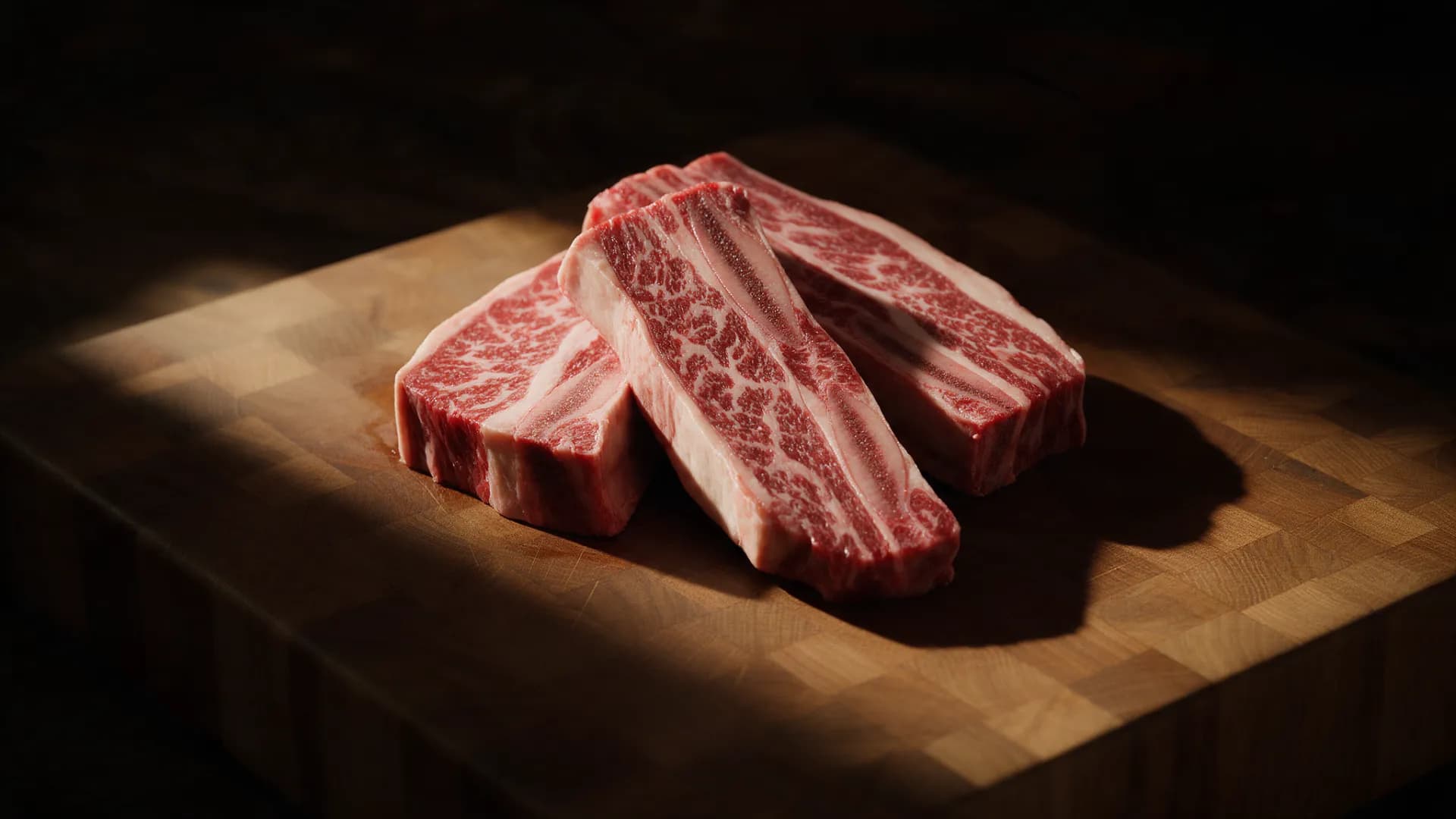
The thick, marbled meat on a good beef rib is mostly one muscle, and it runs along the side of the rib cage. It sits thickest over ribs 5 to 8. As beef muscles go it's one of the more tender ones, well marbled too. It still needs a long cook though, because of everything around it, the fat layers, the connective tissue and the meat stuck to the bone (why low and slow works).
What changes from one rack to the next is how much of that muscle has been left on, how long the bones are, and how many you get.
What to ask for
In the US the big three-bone "dino" rib is the plate short rib, ribs 6, 7 and 8 from under the rib section, with bones around 20–30 cm long. Australian butchery doesn't have a plate. The forequarter splits into the rib set on top, the chuck, and the brisket underneath, which runs right back to the 13th rib.
The AUS-MEAT cut that matches is plain short ribs. They're cut from the forequarter once the brisket and the rib set come off, about 75 mm out from the rib-eye, and the ribs are whatever you and the butcher agree on. Which is why you need to say the numbers.
So ask for short ribs, three bones, ribs 6 to 8 (5 to 8 is fine too), cut long along the bone, with the meat left on top. That's the English cut. Flanken is the same ribs sliced thin across the bones, which is for the grill, not the smoker.
Chuck short ribs, back ribs and "plate ribs"
The front ribs are chuck short ribs, and they carry most of that same muscle. They usually come as four bones, smaller and rounder, and they're cheaper. They smoke fine, and being smaller they should come up a bit sooner.
The bones taken off the rib-eye in one piece are back ribs. The butcher keeps the meat for rib-eye steaks, so there's not much on top and often bone showing through. Fine for gnawing on, not the big rib you're after.
Watch the word plate. In the AUS-MEAT specification plate ribs are rib bones and the meat between them, taken off a bone-in brisket. That's a thin rack, nothing like the US plate short rib. Not every butcher will use the name that way, but don't ask for plate ribs and assume. Check what's on top.
Picking one out of the cabinet
Look at the rack end on. You want thick meat over the bones with fine marbling through it. Walk past racks that are mostly a fat cap over thin meat, or where bone is showing through the top. A US-style three-bone rack runs roughly 1.4–2.3 kg bone-in, and you're paying for the bone too.
Cook it like a small brisket
Both my beef rib cooks so far were short ribs, though I didn't write down which rib numbers or who I bought them from. So take them as one cook each.
I left the fat cap on both times and scored the membrane on the bone side both times (an X on the first). On the second I salted the meat first and put the rest of the rub on after, because the first one came out slightly salty. These days I'd weigh the salt instead (dry brining).
Both went on unwrapped. The first hour ran cooler, around 93–100°C, then 130–135°C. I spritzed with apple cider vinegar, Worcestershire and water a few times (to spritz or not). They stalled in the 60s, around 68°C on the first and 62°C on the second, same as a brisket does (why your brisket stops climbing). Franklin runs his at about 140°C (285°F) for 8–9 hours and doesn't wrap them either. There's enough fat in a beef rib to stay moist without it.
The untrimmed cap rendered and barked fine both times (fat).
When are beef ribs done?
When a probe slides in between the bones like warm butter. That's usually somewhere around 92–96°C (198–205°F), and Franklin says about 95°C (203°F). Unlike pork ribs, beef ribs are thick enough to probe properly (pork ribs: does 3-2-1 work?).
My first one probed soft at about 91°C and I pulled it at 91–93°C, about six hours in. Soft with a slight chew deeper down, the fat well rendered including the marbling, and the bone came away clean. A touch dry maybe, though it had also sat in an esky for a couple of hours and been warmed on the grill.
The second started feeling soft around 85°C and I pulled it at 92°C. My notes from that one: "Nicely rendered fat, meat soft and juicy. Perfect bark even though fat cap was untrimmed. Good bone pull back. Could have gone another degree or two for extra softness."
Beef is safe as a whole cut at 63°C (145°F) plus a short rest in Australia, and ribs finish about 30°C above that. The extra time is all about softening the fat and connective tissue.
Rest it, then cut between the bones
Give it at least 30 minutes. If dinner's a way off, wrap it and put it in a towelled esky, which is what I did on both cooks. The second one came out of the esky at about 65°C and went straight to the table.
Quick answers
What are dino ribs called in Australia?
There's no single label. They're the short ribs from the middle of the rib cage, ribs 6 to 8, with the thick meat left on top. In AUS-MEAT terms that's "short ribs", with the rib numbers agreed with the butcher. Ask for three bones from ribs 6 to 8 or 5 to 8, cut long along the bone, and check there's real meat over the bones.
What's the difference between chuck and plate short ribs?
Where they sit on the rib cage. US plate short ribs, the big three-bone rib, come from ribs 6 to 8, with long, wide bones and the thickest meat. Chuck short ribs come from ribs 2 to 5, nearer the shoulder. They're smaller and rounder, with a bit less meat, and cheaper. Both carry the same main muscle and both smoke well.
What temperature are beef short ribs done?
Usually around 92–96°C (198–205°F) in the meat between the bones, though feel matters more than the number. A probe should slide in like warm butter. Whole cuts of beef are safe at 63°C (145°F) with a short rest, so the extra time is for softening fat and connective tissue. Beef ribs are thick enough to probe, unlike pork ribs.
Should I wrap beef ribs?
You don't need to. Franklin cooks them unwrapped, and a beef rib has enough fat to stay moist through a long cook. Wrapping speeds things up but softens the bark. If you do wrap, do it late, once the bark is set.
For the curious
The muscle on top is the serratus ventralis (AUS-MEAT 2465 short rib meat, ribs 5 to 8). Belew and colleagues rated it among the more tender of 40 beef muscles in a 2003 shear-force study, though that was on steaks rather than long-cooked ribs. The AUS-MEAT definitions (short ribs 1686–1694, chuck short ribs 1631, plate ribs 1671, back ribs 1697) come from a 2005 edition of the beef specifications, with the names confirmed in the 2023 code list. The US cuts are IMPS 123A (plate short ribs, ribs 6–8), 130 (chuck short ribs, ribs 2–5) and 124 (back ribs) in the USDA's specifications. Texas A&M's 123A page has the anatomy. Franklin's method is in Franklin Barbecue: A Meat-Smoking Manifesto (2015). Food-safety numbers follow FSANZ, healthdirect and Food Safety Information Council guidance, checked 26 October 2026.
If you're between Rockhampton and Bundaberg and would rather someone else watched the pit for your next event, that's what I do. Get a rough price →