Why is my brisket dry? Read the slice
By Tim · 28 October 2026 · 10 min read
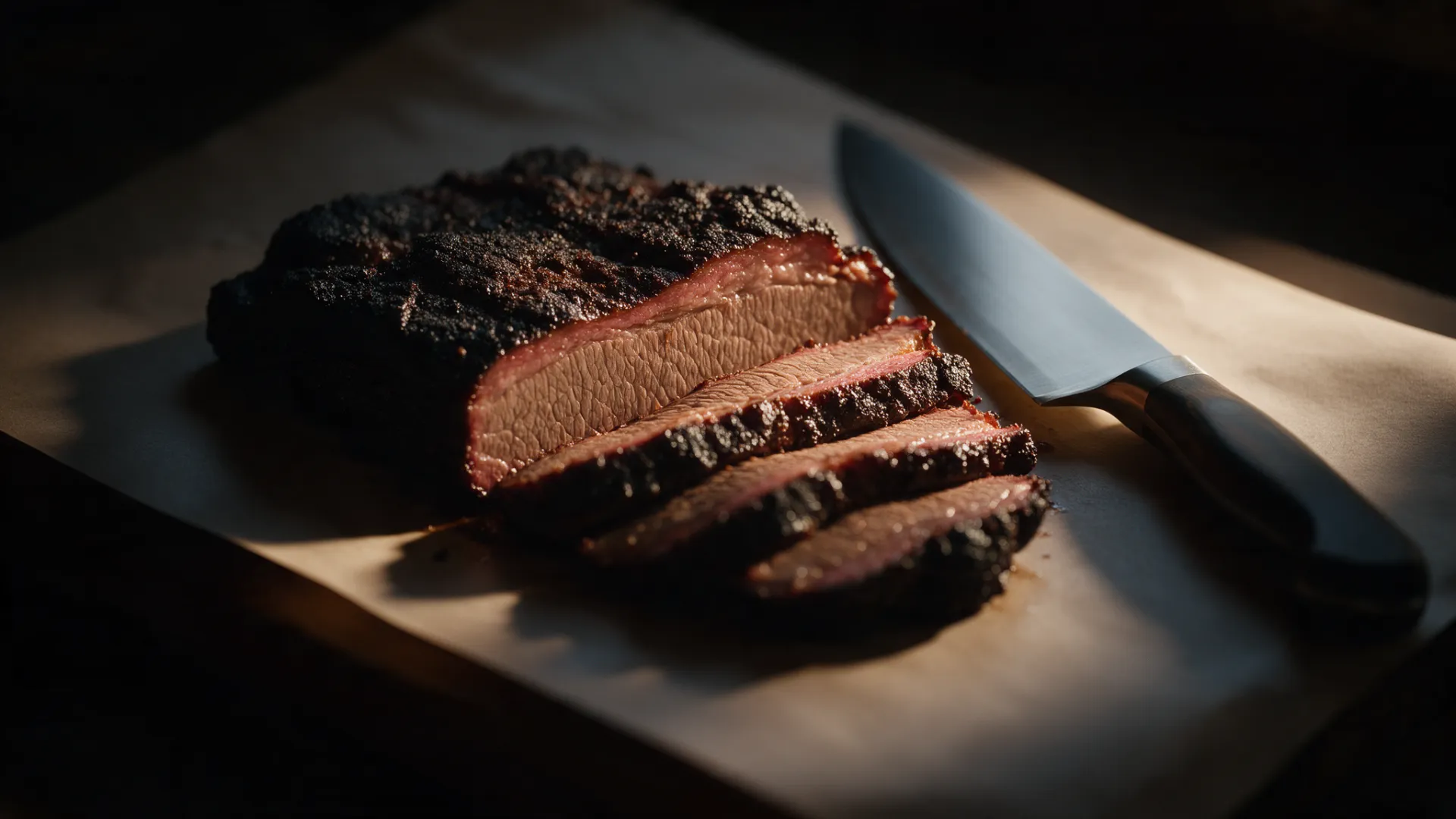
Look at the slice. Crumbly means overcooked. Tough and chewy but still wet means undercooked, so it needed more time. Dry and chewy at once means it went past done, often in a long hot hold. A dry flat beside a juicy point is mostly the flat. Fine on the board but dry on the plate means it sat sliced or was reheated.
On this page · 12 sections
Some of it is just cooking
Every brisket loses water. In a 2020 study at the University of Melbourne, small blocks of beef lost about a fifth of their weight at 60°C (140°F), nearly a third at 70°C (158°F) and over a third at 80°C (176°F). The muscle fibres tighten up as they heat and squeeze the water out. A brisket goes to 90°C (194°F) and past, so some of that loss is what you signed up for when you lit the fire.
The juiciness you notice is mostly the juice that comes out in the first few chews. Plus melted fat inside the meat keeps the fibres slick, which is why a fatty bit eats moister than a lean bit cooked the same. So when people say "dry" they can mean a few different things, and the slice is the best clue you've got to which one it was.
Crumbly and dry means overcooked
A Texas A&M team smoked 96 briskets for a study published in 2025. Some they took to 75°C (167°F), some to 80, 85 or 90°C, and half of each lot was held for 3 hours at that temperature. Their trained tasters scored the flat less and less cohesive the further it went, close to half as cohesive at 90°C, or at 85°C with the 3-hour hold, as it was at 75°C. The point fell apart even more. Those were tasters eating reheated slices in the study, but the direction's clear enough. The ones taken to 90°C and held 3 hours wouldn't even hang over a table edge, they just broke.
You pay for that in meat too. Over the same range, in a commercial smokehouse, the yield went from about 73% to about 56%. Off a 5 kg trimmed brisket that's roughly 3.6 kg of cooked meat against 2.8 kg.
My brisket in March 2025 was overcooked even though the probe read 96°C (205°F), and my note from it says "start probing earlier". That's one cook, and there's no single number where brisket goes crumbly. It's a slope, hotter and longer.
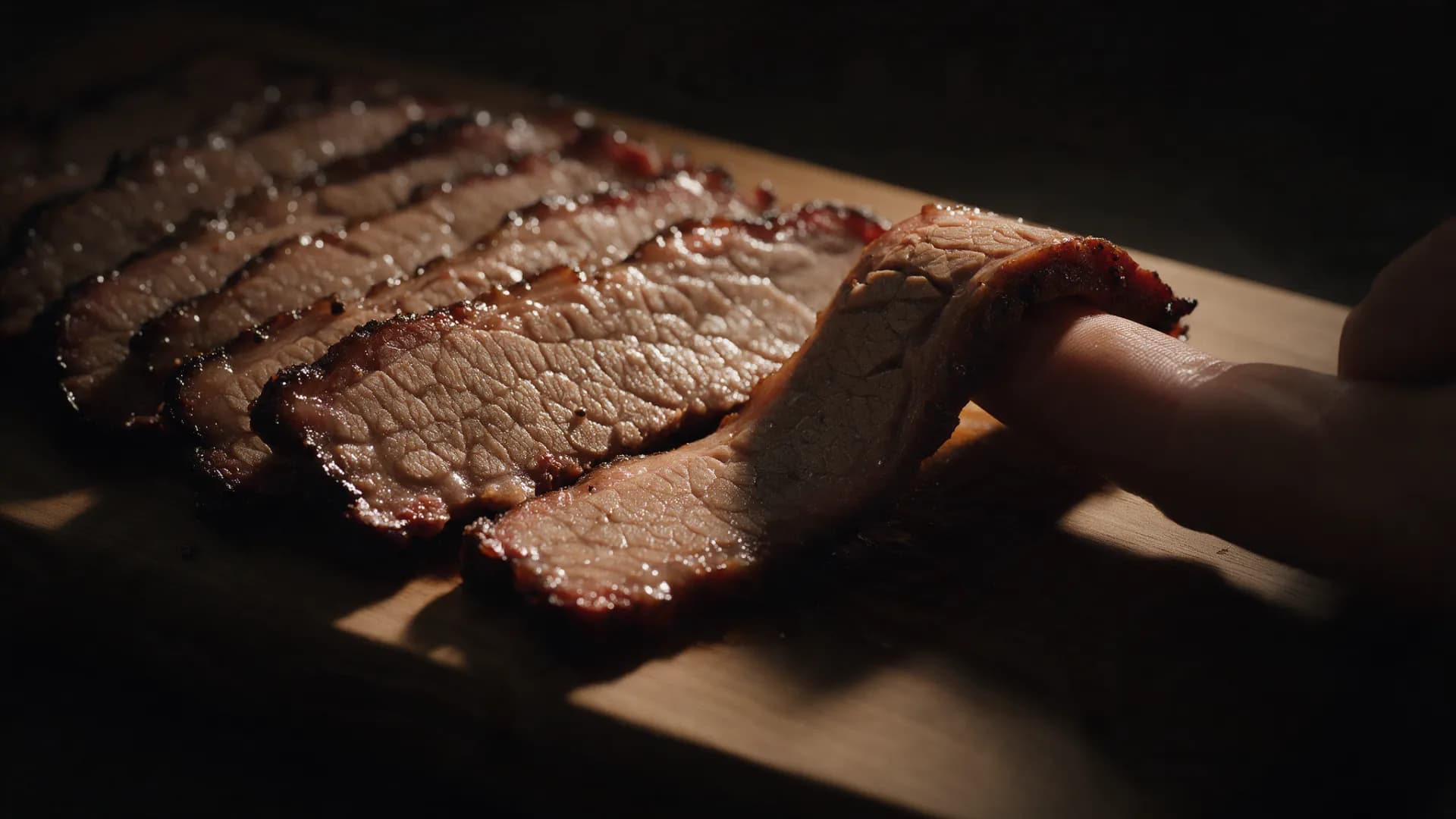
Aaron Franklin's check is a good one. Hold a slice between both hands and pull it gently. It should break easily. If it crumbles it's overdone, and if it stretches it needed longer.
Tough and chewy, but still wet?
Tough but wet brisket is undercooked. People call it dry but it usually isn't. In the Texas A&M study the least-cooked briskets, 75°C with no hold, had the most connective tissue left, the toughest fibres and, in the point, the most juice coming out when you bit it. It can feel dry because you're chewing it for so long, though nobody's measured that.
The fix is more time. In that study a 3-hour hold at 75°C softened the middle more than taking it on to 85°C without one. On my baseline brisket in July 2025 the fat was soft at 91°C (196°F) but the meat was still tough, and it was probe tender at 93°C (199°F). So go by feel, and if it's still fighting the probe, leave it on (why low and slow works).
What does dry and chewy at the same time mean?
The forum rule says dry and tough means undercooked. It misses a case. In the Texas A&M data the flat held 3 hours at 90°C was tougher than the flat pulled at 90°C, about 38% more force to cut through it. Muscle fibres that have cooked too far have tightened and squeezed their water out, so they're tough and dry together.
Which means when a slice is chewy, ask if it was also dry. Chewy and wet, it needed more time. Chewy and dry, it went too far, and often that happened after it came off the pit.
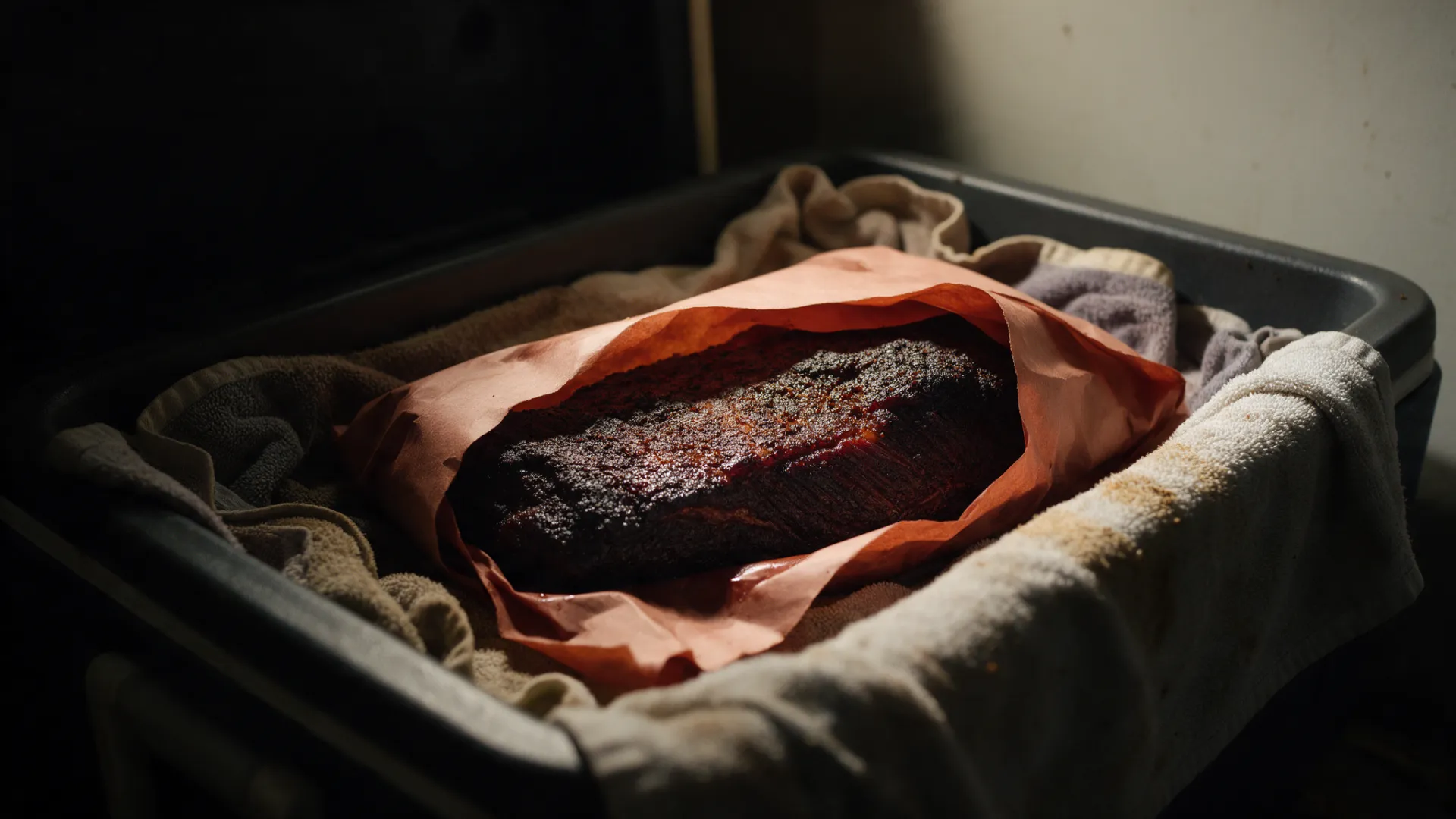
I ran into the same thing on my 26 July 2026 brisket, which was a bit of an experiment with a benchtop oven as the holding box. It was a 2.1 kg flat-dominant piece and the lean was probe tender when I pulled it, about 94°C (201°F) by the time it got to the oven door. Then I over-corrected the holding oven and it sat at about 72°C (162°F) for two hours or more. Everyone eating it said dry. Slightly chewy, and a slice only bent to about 70 degrees, nowhere near a drape. It was already done when I pulled it and then I cooked it for another couple of hours. It was injected and lean and I'd changed the rub, so that's one cook, but the hold's my prime suspect. The whole story's in resting and holding a brisket.
Franklin says much the same about cooking on because you're unsure, that "you're just going to dry it out and make it tough".
Why is the point juicy and the flat dry?
They're two different muscles. In a 2024 Texas Tech study of Australian and US briskets, consumers scored the point 66.9 for juiciness and the flat 46.3, out of 100. Cooked, the point was about 11% fat and the flat about 7%. Harold McGee puts it well, without much fat "otherwise tender meat becomes compacted, dry, and tough".
A fattier flat is a juicier flat. In an earlier study, consumers scored US Prime flats 60.6 for juiciness against Select's 53.8, while the point scored about the same whatever the grade. With Australian beef, grass-fed or grain-fed made little difference to juiciness within a grade. The animal's age did. Maturity was the carcass trait most strongly linked to tough brisket, and it went with drier eating too, and briskets from cull cows lost 45% of their weight against 38–41% for the rest.
So a flat on its own is the hard version. I've learnt it's better to choose the fattier ones and trim it myself. What I do is probe the flat and pull on the flat, and let the point look after itself. Franklin wraps a lean brisket in foil and early, because he reckons it needs all the moisture it can keep (butcher paper vs foil vs naked).
Cooking yield (%): the meat you have left
Weighed hot, straight after the cook and any hold.
- 75°C, no hold72.9%
- 75°C, 3 h hold62.2%
- 80°C, no hold64.8%
- 80°C, 3 h hold61.4%
- 85°C, no hold63.2%
- 85°C, 3 h hold59.2%
- 90°C, no hold58.4%
- 90°C, 3 h hold55.7%
Flat cohesiveness (1–15): lower is more crumbly
Trained tasters, on the study's own scale: 1 is extremely crumbly, 15 extremely cohesive.
- 75°C, no hold12.0
- 75°C, 3 h hold8.5
- 80°C, no hold9.6
- 80°C, 3 h hold8.8
- 85°C, no hold9.6
- 85°C, 3 h hold6.2
- 90°C, no hold6.3
- 90°C, 3 h hold7.0
Flat shear force (N): higher is tougher
The machine's force to cut through the flat. Shown for the two 90°C treatments the article compares.
- 90°C, no hold16.3 N
- 90°C, 3 h hold22.5 N
96 briskets in a commercial smokehouse, half of each lot held 3 hours at its finish temperature. Kerth et al. 2025.
| Finished at | Held | Yield (%) | Flat cohesiveness | Flat shear force (N) |
|---|---|---|---|---|
| 75°C (167°F) | no | 72.9 | 12.0 | not compared here |
| 75°C (167°F) | 3 h | 62.2 | 8.5 | not compared here |
| 80°C (176°F) | no | 64.8 | 9.6 | not compared here |
| 80°C (176°F) | 3 h | 61.4 | 8.8 | not compared here |
| 85°C (185°F) | no | 63.2 | 9.6 | not compared here |
| 85°C (185°F) | 3 h | 59.2 | 6.2 | not compared here |
| 90°C (194°F) | no | 58.4 | 6.3 | 16.3 |
| 90°C (194°F) | 3 h | 55.7 | 7.0 | 22.5 |
Juicy on the board, dry on the plate
Brisket is best the day it's cooked. In a 2024 Texas Tech study of Australian and US briskets, people scored same-day brisket higher on everything than the same briskets chilled for a week and reheated, and juiciness dropped the most, 59.4 against 53.8.
I reckon slices dry out while they wait, too. The cut faces lose moisture and go grey. I set the hold to 65°C (149°F) and slice to order so it stays hot and juicy. Franklin's the same, he reckons an unsliced brisket stays juicier and fresher for longer. Nobody's put a number on it that I've found, but leave it whole until someone's holding a plate.
I catch the juice as well. Whatever runs onto the board or sits in the wrap is the brisket's own juice and fat, so I pour it back over the slices.
With leftovers I'll often rewarm them in a bath of gravy and make up sandwiches. The liquid coats the meat so it eats better, though it doesn't put back the water the fibres have already lost.
Stringy? Check the grain
If you're tearing long strands with your teeth, it was sliced along the grain. Cut across it and every bite is short fibres. America's Test Kitchen measured it on flank steak and slices cut with the grain took about four and a half times the force to bite into. It shows up in brisket too. In Texas Tech's 2024 brisket study the same brisket served pulled, where you end up biting long strands, scored less tender and less juicy than when it was sliced or chopped.
The two muscles in a brisket run in different directions, roughly at right angles the way I see it. So separate the point from the flat and turn the point before you slice it.
Whole: two muscles, the grain at roughly right angles
Separated, point turned: slice across each grain
Amber: the flat's grain. Red: the point's grain. Dashed: where the knife goes. Schematic, not to scale.
Things that won't fix it
A spritz can't put water back into the meat (to spritz or not). Salt and injection change how much water the meat holds onto, but overcooking and a hot hold cost far more (does injecting work?). And the fat cap doesn't baste anything. What counts is the marbling inside (fat side up or down).
At your pit next time
- Pick a fattier brisket and trim it yourself.
- Probe the flat and pull it when it's probe tender, whatever the number says.
- If it's still tough on the probe, give it more time.
- If it has to wait, keep the meat at 60°C or hotter with a probe in it, and remember a hold is still cooking.
- Rest it whole and slice to order, the flat about 6 mm, across the grain of each muscle.
- Pour the board juice back over.
- Next time it's dry, do the pull test on a slice and ask was it dry and chewy, or wet and chewy.
Quick answers
Is dry brisket overcooked or undercooked?
It depends how it's dry. If it crumbles or falls apart, it's overcooked. In a Texas A&M study, brisket generally got more crumbly as the finish temperature and the hold time went up. If it's tough and chewy but still wet when you bite, it's undercooked and needs more time. Dry and chewy together often means the flat went past done, sometimes in a long hot hold.
Why is the point juicy and the flat dry?
Because they're different muscles. The point carries much more fat inside it. In a study of Australian and US briskets the cooked point was about 11% fat and the flat about 7%, and consumers scored the point far juicier. Melted fat keeps the fibres slick, and the lean flat has less margin. So probe the flat and judge doneness on it.
Can you fix brisket that's already dry?
Not really, but you can make it eat better. Water lost from the fibres doesn't go back in. Warm sliced brisket gently and covered in its saved juices, stock or gravy so the liquid coats every slice, until it's steaming hot and 75°C (167°F) in the centre. I'll often make up sandwiches with it, or put it on a pizza or in a pasta.
Does reheated brisket come out drier?
A little, yes. In a Texas Tech study consumers scored brisket served the day it was cooked higher on every trait than the same briskets chilled for a week and reheated, and juiciness dropped the most. Serve it fresh if you can. If you have to cook ahead, chill it quickly, reheat it in its juices and eat it within two to three days.
Does slicing against the grain really matter for brisket?
Yes. Cut with the grain and you get long fibres you have to tear with your teeth, which reads as tough and chewy. In a test-kitchen measurement on steak, slices cut with the grain took about four and a half times the force to bite. A brisket's two muscles run different ways, so separate the point from the flat and turn the point before slicing.
For the curious
What the tasters scored as crumbly is cohesiveness, and the machine measure of toughness is Warner-Bratzler shear force. The weight a brisket loses is cooking loss, the other side of yield. The animal-age score graders use is ossification.
The finish-temperature and hold study is Kerth et al. 2025. The Australian and US briskets, point against flat, same-day against reheated and sliced against pulled, are Johnston et al. 2024, and the grade study is Fletcher et al. 2021. How much water beef loses at each temperature is Vaskoska et al. 2020. The grain test is America's Test Kitchen's how to slice steak. McGee's line is from On Food and Cooking (2004), and Franklin's pull test is in Franklin Barbecue: A Meat-Smoking Manifesto (2015). The food-safety numbers follow FSANZ, Queensland Health and Food Safety Information Council guidance, checked 26 October 2026.
If you're between Rockhampton and Bundaberg and would rather someone else worried about the flat for your next event, that's what I do. Get a rough price →